Deep — Twenty-Five Cells, Established on Evidence
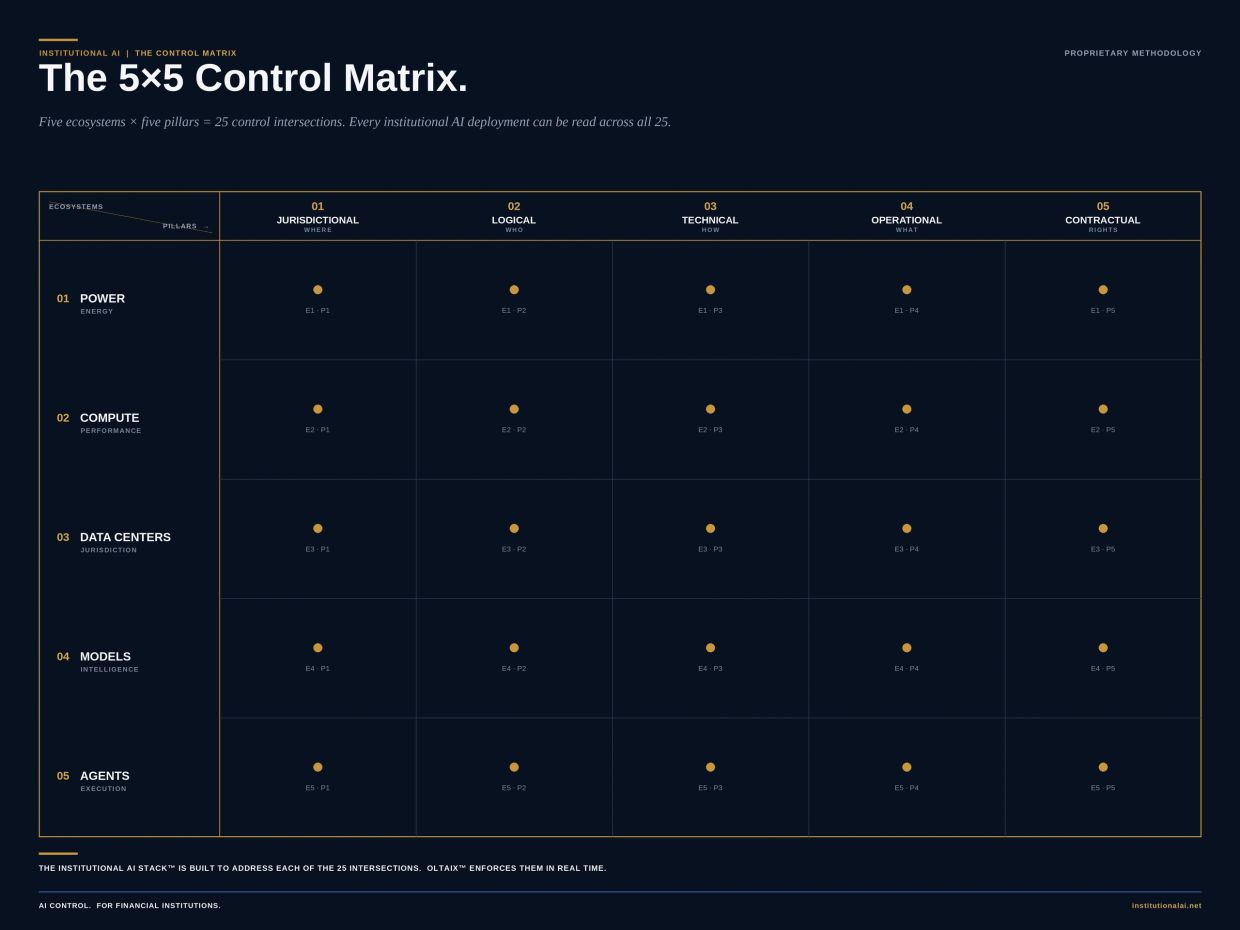
Not "do you have a policy." "Can you prove it — and where does the proof stop?"
Your own AI runs on five ecosystems — Power, Compute, Data Centers, Models, Agents — and control over each is exercised through five pillars: Jurisdictional, Logical, Technical, Operational, Contractual. That is twenty-five specific, answerable questions, and we answer every one against the record, not the reputation.
This is forensic work. For the Models cell under the Technical pillar: is there a named registration-and-validation mechanism that no model bypasses — and can you evidence it to an auditor, or only describe a platform? For Data Centers under Jurisdictional: can you prove where your data physically resides, or only assert it? For Agents under Operational: is every autonomous action traceable to a mandate, or does the trail break?
Each cell is placed on the five-tier scale — Sovereign, Governed, Evolving, Reactive, Not Disclosed — by what the evidence supports. A tier above the baseline requires an identifiable, auditable mechanism; it is never inferred from size, spend, or the volume of AI activity. The result is not a grade. It is a map of exactly where your control is real and where it is a story you've been telling yourself.
Wide — A Matrix for Every Node in the Chain
.png/:/rs=w:1240,cg:true,m)
FROM ASSET SERVICERS TO CLOUD PROVIDERS TO FRONTIER MODELS. We map it, and we run the matrix on each node.
This is the work almost no one else does, because it is the work that leaves your walls. The AI shaping your capital runs inside your asset managers, your servicers, your technology and model providers. You hold the duty; they hold the AI. So each material relationship gets its own full 5×5 — a distinct matrix, node by node.
We start where control actually enters the chain: the contract. The contract is the door. What your agreement with a given provider grants — audit rights, exit rights, data isolation, and critically, whether those rights flow down to their sub-processors — determines how far into that node's twenty-five cells you can actually see and enforce. A strong contract opens the door onto their matrix; a weak or inherited one leaves you accountable for cells you cannot even read.
The same provider reads differently for every institution, because control lives in the contract and the reach it grants, not in the vendor. And the most important output of the wide work is the line the analysis draws for you: where your duty extends further than your reach. That gap — material AI you answer for but cannot currently verify — is the single most valuable thing this work surfaces, and it is invisible to any assessment that stops at your own perimeter.
Then We Close the Gaps
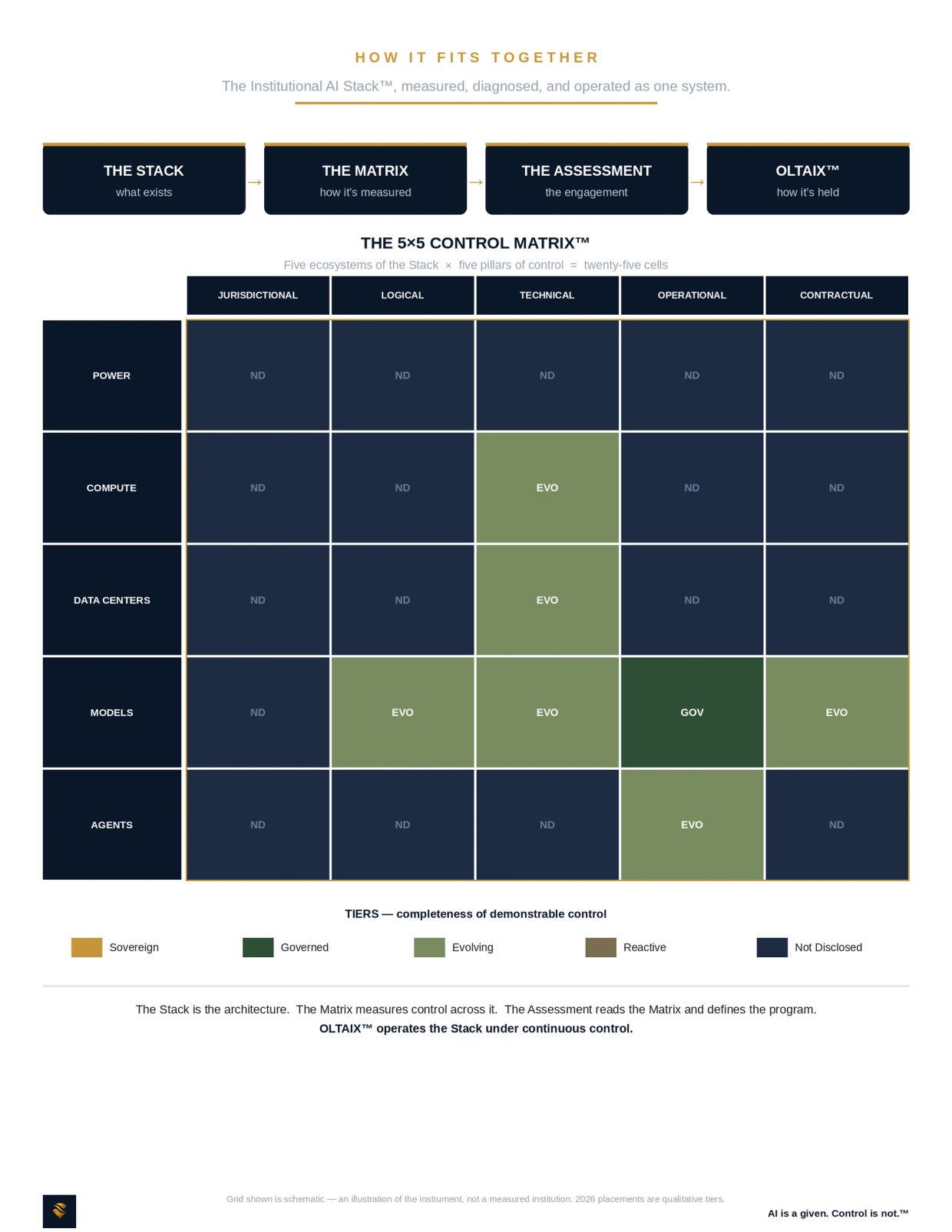
The matrix makes the gaps visible — deep and wide. The architecture closes them. The fabric holds them closed.
The populated matrix — yours and every node's — is the baseline. From it:
The Institutional AI Stack™ designs what closes the gaps: the specific control mechanisms required at each ecosystem, calibrated to your obligations and your chain — not a generic blueprint, but your architecture, instantiated to what you must be able to prove.
OLTAIX™ — the control fabric — holds it in place: enforcing the five pillars across every ecosystem in real time, and carrying the control perimeter across the chain, so a delegate's output arrives with verifiable provenance rather than on assurance.
The Assessment reveals. The Stack closes. OLTAIX™ holds. One system — established deep, extended wide, owned by you.
Why Institutional AI

We are structurally independent — so the matrix is honest.
No hyperscaler alliances. No model-vendor partnerships. No systems-integration practice. No resale economics. No platform whose adoption we are incentivized to recommend. When we populate a cell as Reactive, or draw the reach boundary short, no revenue line bends the finding.
Every other advisor's economics are wired into the answer they give you. Ours are not. That is not a claim — it is the structure of the firm.

We do the wide work.
Assessing your own operations is table stakes. Running a matrix on every node in your delegation chain — reading the contracts, testing the flow-down, drawing the reach boundary — is the work that maps to your actual fiduciary exposure.
It is harder, it leaves your walls, and it is where your real risk lives. It is also what almost no one else will do.

The architecture is yours when we leave.
The engagement produces control the institution owns and operates — independent of any continuing relationship with us. Control that is outsourced is not control. We are engaged to make you independent of us, not dependent on us.
That, too, is a structural difference.
We built the instrument.
The 5×5 Control Matrix™ is ours, from the research that established the discipline — The State of AI Control in Institutional Finance, eighty institutions, eight sectors, two thousand cells.
You are not being measured against a consultant's opinion. You are being measured against a documented methodology, applied the same way to the whole industry.
The RELATIONSHIP
Selective. Scoped. Confidential.
Institutional AI accepts a limited number of engagements. Each is scoped to the institution's obligations, AI footprint, and delegation chain, and each begins with a confidential AI Control Assessment™ for qualifying institutions. What remains at the end is a control position you can stand behind — before the board, the regulator, and the client — and the evidence to prove it.