THE AI CONTROL GAP
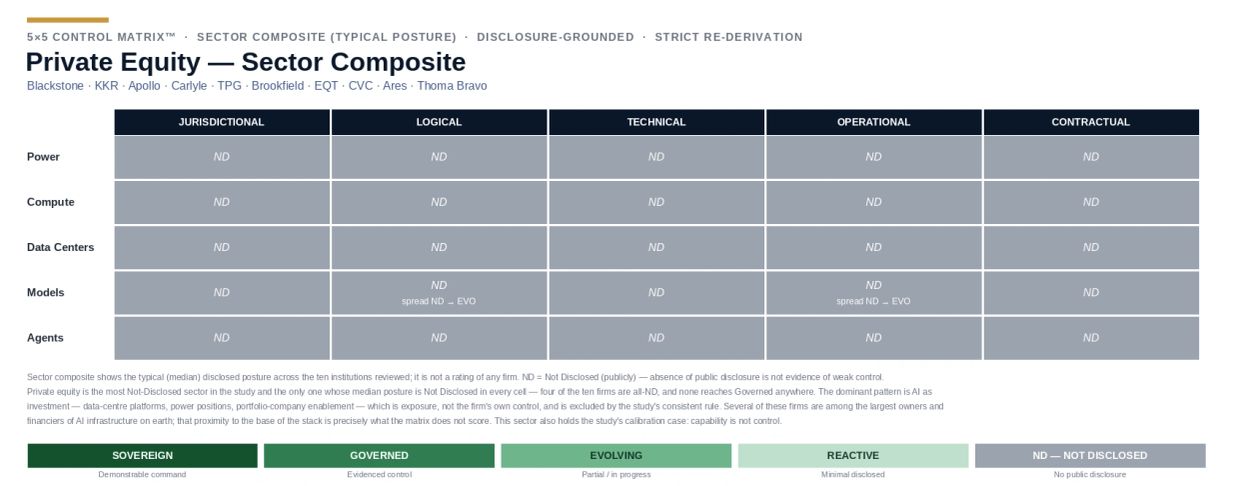
What the sector shows
Within this study, private equity is the least-disclosed sector on the public record reviewed: the typical posture is undisclosed across every cell.
The explanation is structural rather than a judgment of sophistication. The dominant AI footprint in the category is investment — funds and stakes directed at AI infrastructure and AI companies — together with AI deployed inside portfolio companies. Neither is the firm's own internal control of its own AI, and this report reads only the latter.
The range tops out at an evolving stage at a small number of firms that disclose a named internal capability; for most of the category, control of the firm's own AI is simply not the subject of public disclosure. The sector is the clearest illustration in the study that scale of AI activity and exposure is not the same as control.
SECTOR OVERVIEW
Large-Cap and Global PE Firms
Their Mandate: Generate superior risk-adjusted returns across large, complex transactions and multi-asset portfolios — with LP capital from the most sophisticated institutional investors in the world, who are beginning to ask hard questions about AI governance.
Core Challenges:
- Deal intelligence sovereignty → Proprietary deal flow, investment thesis development, and competitive intelligence processed by external AI under standard terms is processed on provider infrastructure without institutional protection. The deal signals that define your sourcing advantage are being handled by systems whose terms do not recognize that advantage as yours.
- LP AI governance expectations → Institutional LPs — pension funds, sovereign wealth funds, endowments — are beginning to include AI governance in their manager due diligence processes. GPs deploying AI in investment workflows without a documented governance framework are entering a competitive disadvantage in LP conversations that will compound as due diligence standards develop. "AI-washing" — claiming AI capabilities without verifiable governance — is an increasing LP concern.
- SEC examination readiness → SEC-registered investment advisers including PE firms are subject to increasing examination focus on AI in investment processes. Model risk, data governance, and explainability requirements are developing. The firm without a documented AI governance framework will be materially unprepared for the examination conversation that is already beginning.

Mid-Market PE Firms
Their Mandate: Source, diligence, and create value in middle-market companies — where operational transformation, not financial engineering alone, determines returns, and where the GP's operational expertise is the product.
Core Challenges:
- Portfolio company AI governance inheritance → Mid-market portfolio companies are adopting AI rapidly — often without governance frameworks, without understanding their regulatory exposure, and without the internal capability to assess what they have built. The PE firm that acquires these companies inherits every AI governance gap as a fund-level risk. A post-close discovery of material AI governance failures — data breaches, regulatory violations, operational dependencies on providers who can restrict access — is a value creation plan disruption.
- Operating partner AI bandwidth → Mid-market PE operating partners are under pressure to deliver AI-driven value creation across portfolios. The combination of deployment urgency and governance absence creates a pattern: AI gets deployed, governance gets deferred, risk accumulates silently until something goes wrong. The AI governance assessment is the instrument that reverses this sequence.
- Exit valuation AI governance premium → Strategic and financial acquirers are beginning to include AI governance in their diligence processes. A portfolio company with a documented AI governance profile — scored across 25 specific governance intersections — is a cleaner asset in an M&A process. The governance premium is not yet priced into exit multiples. It will be.

Growth Equity and Venture-Backed PE
Their Mandate: Back high-growth companies at inflection points — where AI is often core to the business model, not just an operational tool, and where the governance of that AI is inseparable from the value of the asset.
Core Challenges:
- AI-native portfolio company risk → Growth companies whose core product is AI-driven face a specific governance challenge: the AI governance of the business is the regulatory and operational risk of the business. Inadequate governance of a portfolio company's AI product creates regulatory exposure that affects exit timing, exit value, and buyer universe.
- Concentration risk in AI infrastructure → Growth-stage companies typically depend on a single cloud provider and one or two major model API providers for their AI capabilities. Provider pricing changes, service restrictions, or geopolitical disruptions create operational fragility that is not reflected in the company's financial model. The AI sovereignty assessment surfaces that fragility before it becomes a fund-level event.
- Investor AI due diligence → As growth equity firms raise new funds and approach institutional LPs, the LP due diligence process increasingly includes questions about how AI is used in the investment process and how portfolio companies' AI is governed. Firms that have developed structured AI governance frameworks across the portfolio will be in a materially differentiated position in these conversations.
PE Transaction Counsel and Operating Partners
Their Mandate: Identify value creation opportunities, manage operational risk, and ensure portfolio companies are positioned for optimal exit — with AI governance becoming an explicit dimension of all three.
Core Challenges:
- M&A due diligence gap → AI governance due diligence is not yet standard in PE transaction processes. The result is that AI infrastructure dependencies, unauditable model deployments, and non-compliant provider agreements are acquired without disclosure and without price adjustment. As AI becomes more embedded in target companies, this gap will produce material post-close discoveries.
- Portfolio company remediation cost → AI governance gaps identified post-close are substantially more expensive to remediate than gaps identified during diligence — when remediation cost can be negotiated into the purchase price or structured as a seller obligation. The difference between a pre-close AI governance assessment and a post-close remediation programme is typically measured in multiples of cost and months of management distraction.
- R&W insurance alignment → Representations and warranties insurance policies were not written for AI governance risks. Coverage gaps around AI infrastructure dependencies, data processing obligations, and model liability are standard across current R&W policies. Transaction counsel that understands AI governance can negotiate representations that create meaningful protection — but only if the governance gaps are identified before the representations are made.
PRIVATE EQUITY — AI USE CASES

DEAL ORIGINATION & INTELLIGENCE
See deals before they exist
Use Cases
- AI-driven market scanning across private and public signals
- NLP extraction from filings, earnings calls, and alternative data
- Founder and asset scoring models based on pattern recognition
- Thematic investing engines — AI infrastructure, energy transition, healthcare digitization
Value Creation
- Proprietary deal flow that compounds over time
- Faster sourcing cycles
- Higher signal-to-noise in screening
Governance Reality Check
Every deal signal query submitted to an external AI model is a window into your sourcing thesis. The provider processes your pipeline intelligence, your sector hypotheses, and your pattern recognition under standard terms that do not recognize any of it as competitively sensitive. Proprietary deal flow is only proprietary if the governance protects it.
Tie to Stack
- Models + Data → predictive deal identification with institution-controlled intelligence
- OLTAIX™ → governs signal trust, bias control, and deal intelligence provenance
AI GOVERNANCE DUE DILIGENCE
Find the gaps before you own them
Use Cases
- Pre-acquisition AI governance assessment across the 5×5 Control Matrix
- AI infrastructure dependency mapping — provider concentration, contractual exposure
- Regulatory compliance gap analysis for target company AI deployments
- Post-close remediation cost estimation and programme design
Value Creation
- Prevention of post-close AI governance surprises
- Purchase price adjustment leverage from identified governance gaps
- R&W insurance alignment through documented pre-close assessment
- Remediation roadmap ready for day-one portfolio company engagement
Governance Reality Check
AI governance gaps do not disappear at close. A portfolio company operating with Level 1 governance across its Models and Agents columns — where client data is being processed without technical controls, agent actions are unauditable, and provider agreements create regulatory exposure — transfers those gaps to the acquiring fund on day one. The AI Sovereignty Assessment is the instrument that surfaces them before that happens.
Tie to Stack
- The 5×5 Control Matrix → structured pre-acquisition governance diagnostic
- Institutional AI Advisory → AI governance due diligence report for transaction counsel
PORTFOLIO VALUE CREATION
Operate every company like a governed intelligence system
Use Cases
- AI operating dashboards across all portfolio companies
- Revenue optimization — pricing AI, demand forecasting, customer intelligence
- Cost transformation — procurement automation, workforce optimization
- AI governance programme deployment across the portfolio as a value creation lever
Value Creation
- Continuous EBITDA expansion through governed AI deployment
- Cross-portfolio benchmarking and operational playbooks
- Faster transformation cycles post-acquisition
- Exit readiness through documented AI governance as a due diligence asset
Governance Reality Check
AI deployed in portfolio company operations without a governance framework is operational risk accumulating silently. When an operating agent autonomously processes customer data, executes procurement decisions, or manages workforce workflows without institution-controlled audit trails, the liability flows upward to the GP. Value creation through AI requires governance infrastructure, not just deployment.
Tie to Stack
- Agentic Applications → operating agents inside portfolio companies under governance
- OLTAIX™ → enforces consistency, auditability, and policy compliance across all assets
RISK, COMPLIANCE & GOVERNANCE
Institutional-grade control across fragmented assets
Use Cases
- Real-time risk monitoring across portfolio companies
- Compliance automation — regulatory, audit, ESG and social impact reporting
- Cybersecurity and fraud detection across holdings
- Scenario stress testing across macro and portfolio layers
Value Creation
- Reduced downside risk across the portfolio
- Institutional LP confidence through documented governance posture
- Stronger regulatory positioning for portfolio companies in regulated industries
Industry Signal
Institutional LPs are increasingly concerned about "AI-washing" — PE firms claiming AI capabilities without verifiable governance infrastructure behind them. The LP that asks for evidence of AI governance across the portfolio and receives a structured, scored assessment response is having a materially different conversation than the LP that receives a policy document.
Tie to Stack
- OLTAIX™ → policy, trust, and audit layer across all portfolio company AI deployments
- Models + Data → risk intelligence with complete provenance
EXIT OPTIMIZATION
Engineer the outcome, not just the timing
Use Cases
- Exit timing models based on market and buyer sentiment analysis
- AI-powered buyer targeting — strategics, sponsors, sovereigns
- IPO readiness analytics and governance documentation
- Data-driven equity story creation and narrative optimization
Value Creation
- Higher exit multiples through documented AI governance as a diligence differentiator
- Reduced time-to-exit through clean AI governance profile
- Broader buyer universe — strategic and financial acquirers who require AI governance documentation
Industry Signal
Strategic acquirers are beginning to include AI governance in their acquisition due diligence. A portfolio company that can present a completed 5×5 Control Matrix with Level 3 governance across its Models and Agents columns is a materially cleaner asset than one whose AI governance is undocumented. The governance premium is not yet priced into exit multiples. It will be. The firms that build it now will capture it.
Tie to Stack
- Models → market and buyer intelligence
- The 5×5 Control Matrix → exit-ready AI governance documentation for acquirer diligence
LP EXPERIENCE & CAPITAL RAISING
Turn reporting into intelligence — and governance into a fundraising advantage
Use Cases
- Real-time LP dashboards — performance, risk, exposure, AI governance posture
- AI-generated reporting and portfolio narratives
- Personalized LP insights — portfolio look-through, scenario modeling
- Capital raising intelligence — target LP identification and relationship management
Value Creation
- Stronger LP trust through real-time transparency including AI governance disclosure
- Faster fundraising cycles
- Differentiated GP positioning through demonstrated AI governance as an LP commitment
Industry Signal
Institutional LPs — pension funds, sovereign wealth funds, endowments — are developing AI governance due diligence standards for the GPs they back. The PE firm that can present a documented, scored AI governance framework across its investment process and portfolio companies will have a meaningful advantage in LP conversations that competing GPs cannot yet replicate.
Tie to Stack
- Agentic Applications → LP interface layer with governed intelligence outputs
- OLTAIX™ → ensures data integrity, consistency, and AI governance auditability across all LP-facing outputs
REQUEST The State of AI Control in Institutional Finance
AVAILABLE ON A RELATIONSHIP BASIS TO QUALIFYING INSTITUTIONS
All engagements and discussions are conducted under confidentiality protections, including NDA where applicable. Control Tiers represent Institutional AI’s analytical interpretation of public disclosure completeness and are not assessments, audits, or certifications of any institution’s actual control environment.
AI is a given. Control is not.™
