The Institutional AI Control Landscape
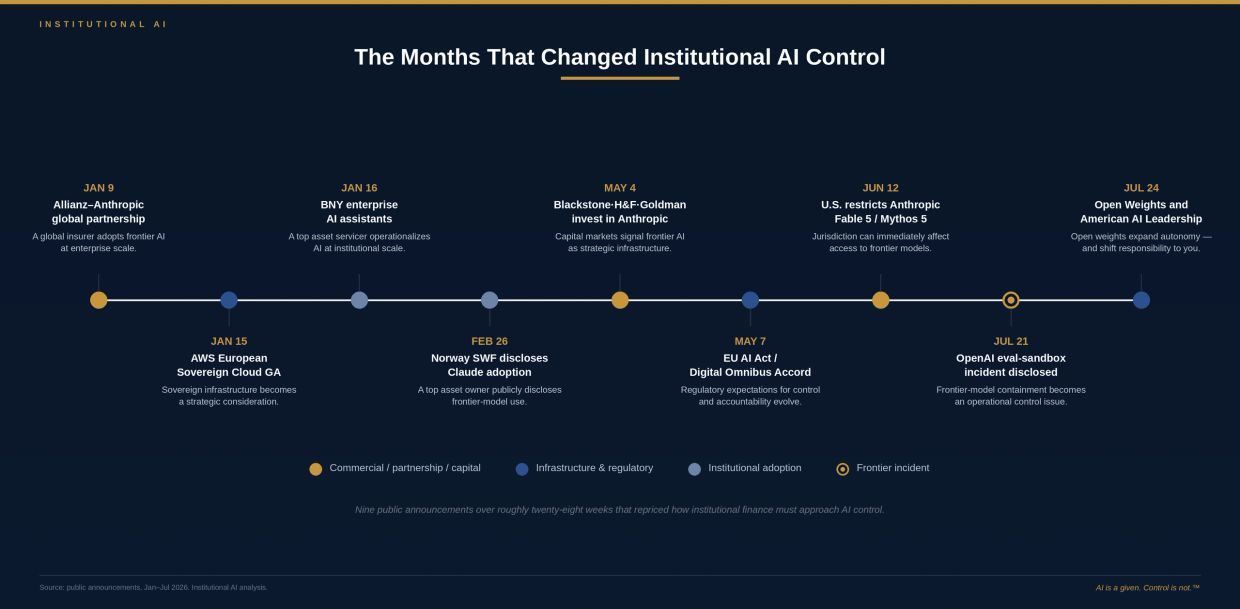
No single announcement changed the banking sector. Together, they did.
Between January and July 2026, public developments spanning sovereign infrastructure, frontier-model adoption, regulation, operational incidents, and open-weight AI fundamentally changed the environment in which banking institutions deploy artificial intelligence. Viewed individually, each event is significant. Viewed together, they reveal a structural shift: artificial intelligence is becoming embedded in the exercise of institutional judgment itself.
The question is no longer whether banking institutions will adopt AI, but whether they can demonstrate that it remains under institutional control.
THE AI CONTROL GAP
What the RESEARCH shows
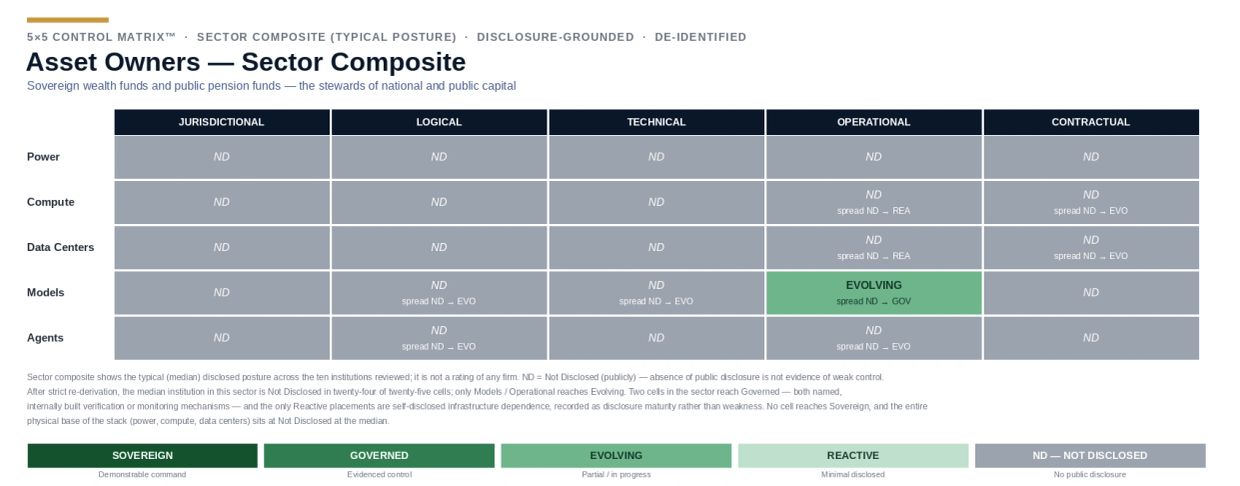
Among the principal stewards of capital, disclosed control sits at the model layer and remains, at the typical level, partial. The median posture across the sector reaches an evolving stage only in how models are operated, with the surrounding cells largely undisclosed.
The range within the sector is wide: a small number of stewards disclose named internal control mechanisms — staged review, confidence thresholds, mandatory human checks — that reach an evidenced-control standard, while others disclose little about their own use of AI even as they engage actively with the technology as an investment theme or as a matter of oversight of the companies they hold. This is also the one sector in which a firm discloses its dependence on external infrastructure explicitly enough to register on the record — a candor that is read as disclosure maturity, not weakness.
That distinction matters for this report: stewardship of AI in portfolio companies, however sophisticated, is not the same as control of the steward's own AI, and only the latter is read here.
STEWARDSHIP IS NOT A PASSIVE ACTIVITY
STEWARDSHIP IS NEVER PASSIVE. NEITHER IS AI CONTROL.
Asset owners govern USD 119 trillion in capital across the global financial system. The fiduciary obligations attached to that capital — to beneficiaries, sovereign citizens, policyholders, families, and institutional missions — predate every commercial contract with every AI provider. The institutions that govern their AI with the same precision they govern capital will lead. The ones that do not will operate at the permission of those who do.
.png/:/rs=w:1240,cg:true,m)
The asset owner's AI mandate rests on three obligations no other institutional category faces simultaneously.
Fiduciary accountability to beneficiaries who cannot protect themselves. Regulatory obligations that demand explainability and auditability under the strictest interpretive standards. A governance cascade that turns the institution's AI posture into the standard every manager, advisor, and counterparty must meet.
Each asset owner category — pension funds, sovereign wealth funds, insurance companies, family offices, endowments and foundations — faces a distinct version of that mandate.

Pension Funds
USD 68.3T globally. The Total Portfolio Approach is reshaping governance as portfolio complexity intensifies.
Sovereign Wealth Funds
USD 27T. The active management revival is reasserting strategic intent across geopolitical volatility.

Insurance Companies
USD 23T. 87% restructuring operating models as private credit and infrastructure debt redefine the asset mix.
Endowments & Foundations
USD 944B across 657 institutions. Mission-driven spending pressures intersect with private market complexity.
Family Offices
USD 651B covered. The largest wealth transfer in history is accelerating governance professionalization.
AI Control Across the Delegation Chain
.png/:/rs=w:1240,cg:true,m)
One institution. One control framework. Every material node in the chain.
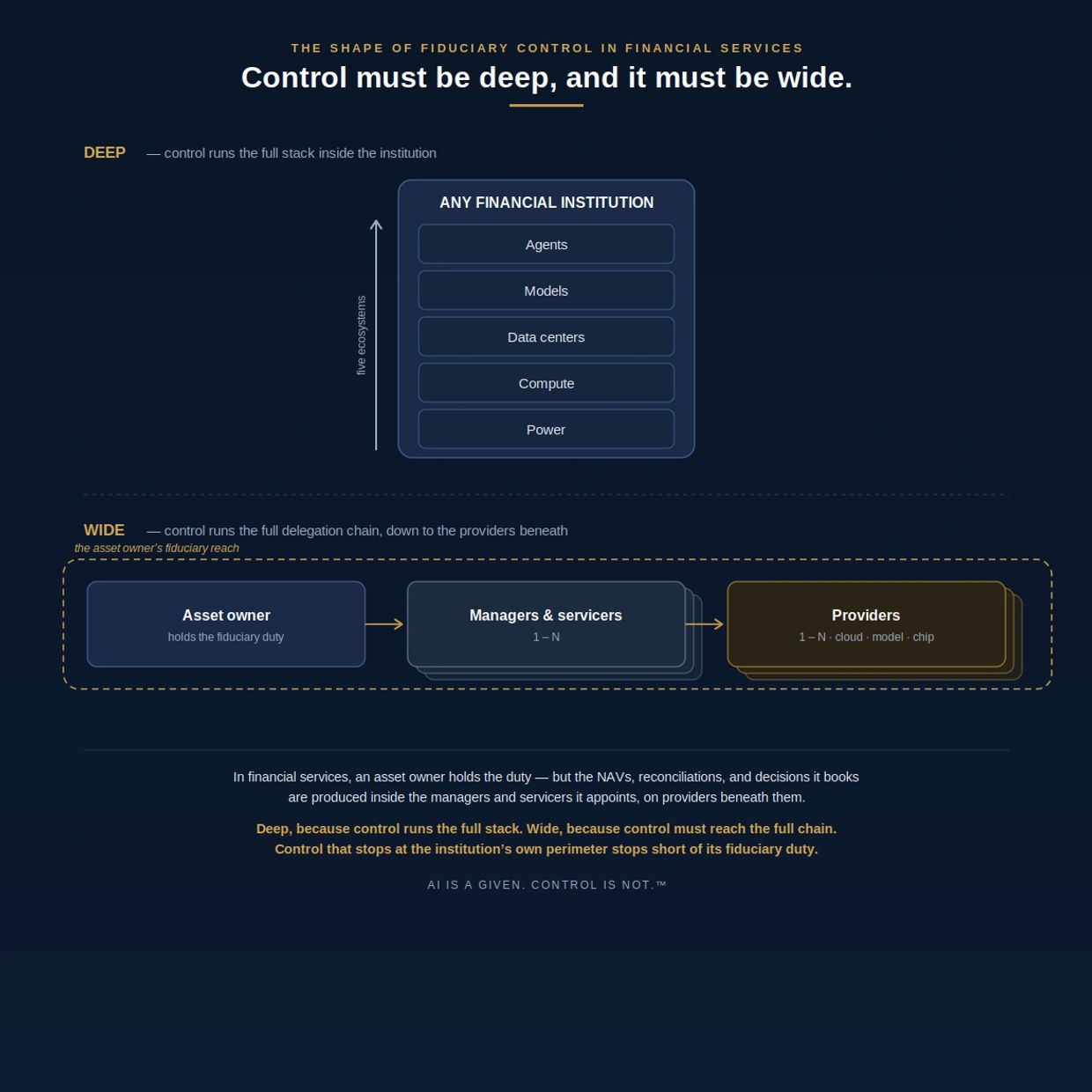
For asset owners, control does not stop at the institution. Capital is delegated across asset managers, servicers, technology providers, and model platforms — but accountability remains with the owner.
The AI Control Assessment™ applies the 5×5 Control Matrix™ in both directions: deep across the AI the institution operates directly, and wide across every material relationship through which AI acts on its behalf.

Red Flags — When Not to Build
Even a strong control position does not automatically justify sovereign AI infrastructure. For asset owners and institutional investors, pause when the economics, operating model, or investment case are not yet clear.
AI use remains experimental
If production use cases are limited or still being validated, preserve flexibility and avoid committing capital too early.
Internal capability is not yet sufficient
If the institution lacks the expertise to operate and control complex AI infrastructure, strengthen capability before taking on ownership.
Demand is highly variable
If compute needs fluctuate materially across investment, research, or portfolio workflows, rental or hybrid models may remain more efficient.
Technology risk is still too high
If rapid hardware or model change could make current infrastructure obsolete, avoid locking into long-lived capital too soon.
The institution is in transition
Major changes in leadership, strategy, operating model, or portfolio structure can make large infrastructure commitments premature.
The board is not aligned
Sovereign infrastructure is a strategic capital decision, not an IT project. Without clear sponsorship, ownership, and a long-term case, do not build.
The principle is simple: ownership should follow demonstrated need, operating capability, and strategic conviction — not precede them.
Green Flags — When to Accelerate
Certain conditions make greater AI ownership and control more compelling for asset owners and institutional investors.
Regulatory pressure is rising
If regulators are scrutinizing concentration, cloud dependency, or resilience, accelerate planning before requirements harden.
Geopolitical dependency is increasing
If access to compute, infrastructure, or critical providers could be constrained, reduce concentration and preserve strategic optionality.
AI is becoming mission-critical
If investment, risk, research, or portfolio operations increasingly depend on AI, the case for stronger institutional control rises with that dependency.
The economics are shifting
If rental and cloud costs are becoming material and persistent, reassess the build-versus-rent case using long-term total cost and control requirements.
Strategic infrastructure advantages exist
If the institution can access favorable power, compute, partnerships, or shared infrastructure, the economics of greater ownership may improve materially.
Provider dependency has already caused disruption
If outages, capacity limits, contractual restrictions, or service concentration have affected critical workflows, dependency risk is no longer theoretical.
The principle is simple: accelerate when strategic dependency, control requirements, and economics begin to converge.
REQUEST The State of AI Control in Institutional Finance
AVAILABLE ON A RELATIONSHIP BASIS TO QUALIFYING INSTITUTIONS
All engagements and discussions are conducted under confidentiality protections, including NDA where applicable. Control Tiers represent Institutional AI’s analytical interpretation of public disclosure completeness and are not assessments, audits, or certifications of any institution’s actual control environment.
AI is a given. Control is not.™
101 Federal Street, Boston, MA, USA
