MOST INSTITUTIONS BELIEVE THEY ARE DEPLOYING AI
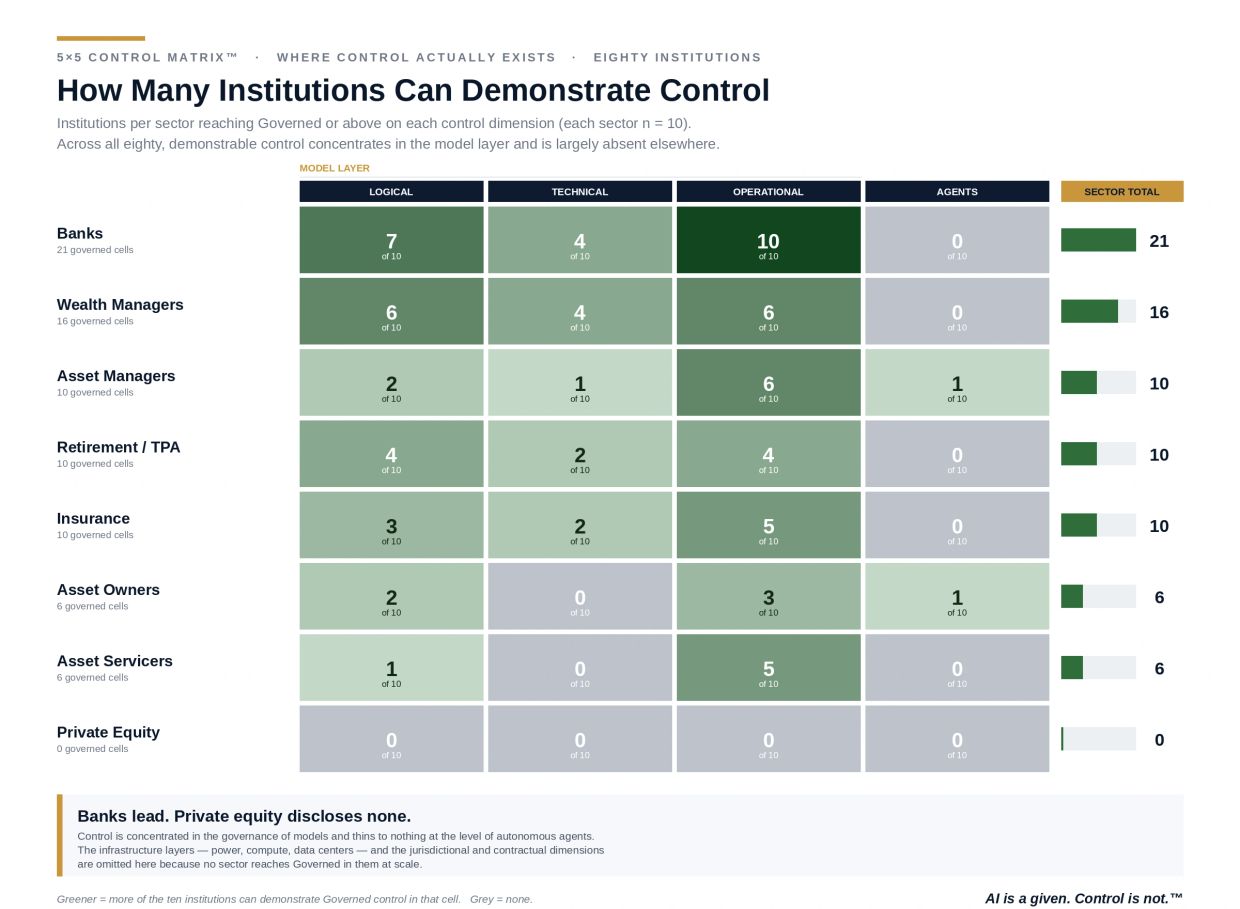
THEY ARE ACCUMULATING DEPENDENCY
Every new capability running on external infrastructure, under standard API terms, with logs held in provider systems, is a governance obligation — invisible, continuous, and compounding. Until a regulator asks a question the institution cannot answer. Until a client demands evidence that does not exist. Until a provider changes terms the institution cannot afford to refuse.
AI Control is the alternative. Own the stack. Govern every layer. Prove every decision.
WHAT IT MEANS IN PRACTICE
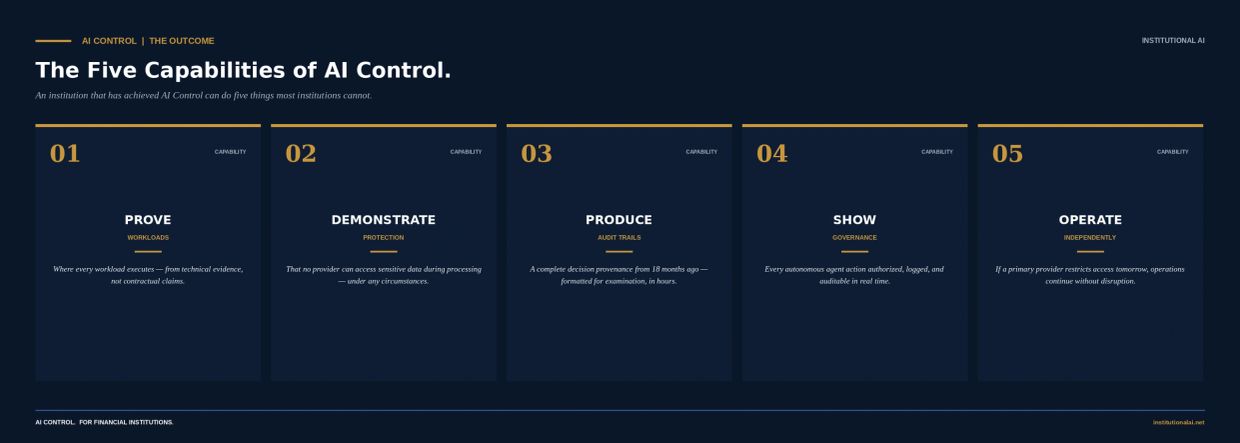
1. Prove where every workload executes. Not based on a provider's contractual commitment. Based on technical evidence, produced in real time, from institution-controlled monitoring systems.
2. Demonstrate that no provider can access sensitive data during processing. HYOK encryption and confidential computing prevent provider access during model inference under any circumstances.
3. Produce a complete audit trail within hours. Any AI-assisted decision from 18 months ago — the model that ran, the data it processed, the policy it operated under, every intermediate output — produced as a formatted examination package from institution-controlled systems.
4. Show that every agent is governed. Every autonomous agent action logged, authorized, and auditable to regulators and the board — in real time, from systems the institution controls.
5. Operate independently of any single provider. If the primary AI provider restricted access tomorrow, operations continue — because institution-owned infrastructure includes the technical and contractual independence that makes any single provider's decisions irrelevant.
WHAT CHANGES WHEN AN INSTITUTION ACHIEVES AI CONTROL

Regulatory relationships change
The institution that can produce examination-ready AI governance evidence within 24 hours occupies a different position with its regulators than the institution spending weeks reconstructing partial answers from vendor logs. Regulators examine what they cannot assume. They extend more discretion to institutions that demonstrate governance than to institutions that assert it.
Client relationships change
Sophisticated institutional clients — pension funds, sovereign wealth funds, endowments — are beginning to ask their service providers about AI governance. The asset manager, the custodian, the wealth manager that can demonstrate AI CONTROL is having a different client conversation than the one that cannot. Trust that is technically enforced is more durable than trust that is contractually promised.
Board governance changes
The board that receives a structured AI governance report — every AI system in scope, its compliance posture, its audit trail, any exceptions and their resolution — governs differently than the board that is told AI governance is in place. Oversight requires evidence. AI CONTROL produces it continuously.
Competitive position changes
AI sovereignty is not yet a universal requirement. It is becoming one. The institutions that build governance infrastructure now will have a structural advantage when regulatory requirements, client due diligence standards, and competitive benchmarks converge around documented AI governance. First movers do not just comply — they set the standard others must match.
Geopolitical resilience changes
The institution whose AI operates on sovereign infrastructure — with HYOK encryption, institution-controlled audit logs, and contractual portability rights — is in a fundamentally different position when geopolitical conditions change, providers are acquired, export controls tighten, or government demands are served on model providers. Dependency is a vulnerability. Control is resilience.
WHAT THE ALTERNATIVE COSTS
.png/:/rs=w:1240,cg:true,m)
AI dependency is not a static condition. It compounds.
Every year of operation under standard provider terms deepens vendor lock-in, increases switching costs, and extends the period during which sensitive institutional and client data has been processed on infrastructure the institution does not control. Every agent deployed without institution-controlled audit logs creates a longer period of unauditable autonomous action. Every model running without drift monitoring creates a longer period of undetected governance degradation.
The institution that defers AI Control is not maintaining its current position. It is falling further behind the governance standard its regulators, clients, and competitors will eventually demand — while the cost of remediation grows with every quarter of deferred investment.
Short-term, AI dependency is cheaper than AI Control. Long-term, it is dramatically more expensive.
AI Control is expensive in years one through three. It creates compounding value across years four through ten and beyond. The institutions that build it early govern the standard. The ones that wait respond to it.
THE SEQUENCE TO AI CONTROL
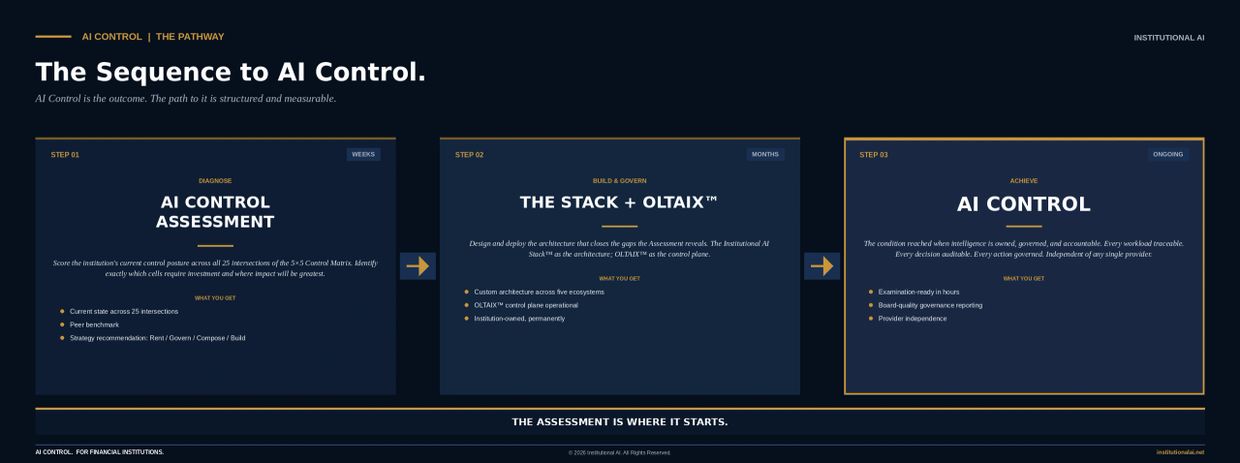
AI Control is the outcome. The path to it is structured and measurable.
The AI Control Assessment tells the institution where its governance stands today — across the 25 specific intersections of the 5×5 Control Matrix. It tells the institution how its posture compares to its peers. It tells the institution which strategy — Rent, Rent + Govern, Compose, or Build — is right for its specific regulatory obligations, AI dependency, risk tolerance, and financial capacity.
The Institutional AI Stack™ is the architecture that closes the gaps the assessment reveals. OLTAIX™ is the control plane that makes that architecture real. Together they produce AI Control — the condition this page describes.
The Assessment is where it starts.