THE AI CONTROL GAP
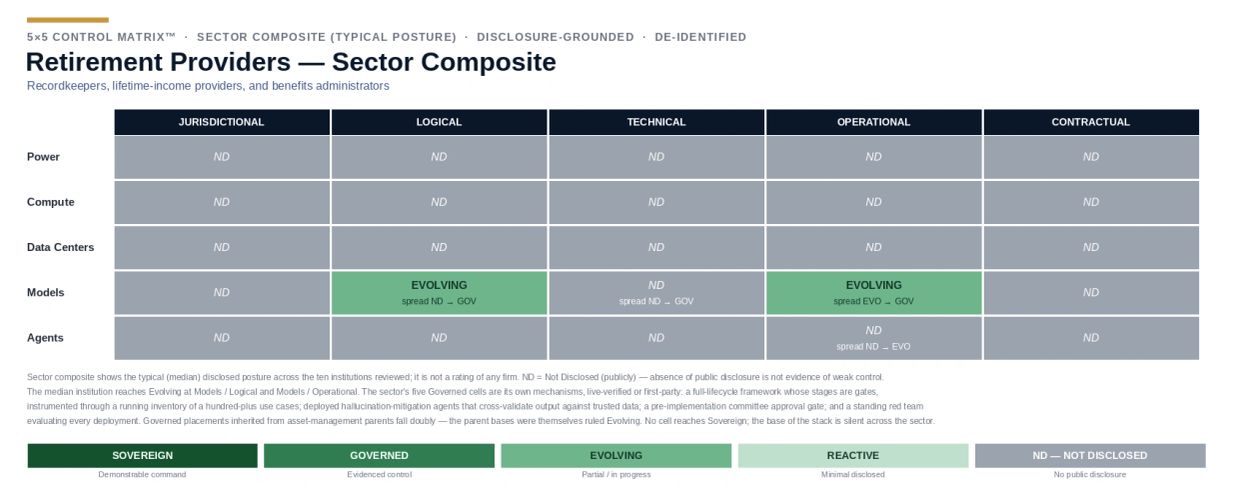
What the sector RESEARCH shows
Retirement and third-party administration providers sit at an evolving posture on the model layer at the typical level, on both the logical and operational dimensions, with the strongest firms in the category reaching an evidenced-control standard through named, full-lifecycle control frameworks and deployed control tooling.
The range is meaningful: several providers inherit disclosed control from an affiliated asset manager or recordkeeping parent, while others disclose stated control intent without a corresponding auditable mechanism.
The sector's leaders increasingly disclose the kind of intake-to-monitoring control framework that distinguishes evidenced control from stated intent.
THE STEWARDS OF AMERICAN RETIREMENT SECURITY

Retirement Plan Recordkeepers
Their Mandate:Administer defined contribution retirement plans for millions of participants with accuracy, security, and fiduciary discipline.
Core Challenges:
- ERISA Fiduciary Exposure → AI systems performing compliance testing, retirement income projections, and benefit determinations carry ERISA's full fiduciary standard to every technology layer running them.
- Participant Data Sensitivity → Social Security numbers, beneficiary designations, and hardship documentation represent the most sensitive personal financial data in the US financial system.
- DOL Examination Readiness → ERISA Section 504 grants the DOL authority to demand any records related to plan administration — including AI system logs that most providers do not hold in institution-controlled systems.
- SECURE 2.0 Obligations → New provisions for retirement income projections, emergency savings, and auto-portability create expanded AI use cases, each carrying ERISA's fiduciary standard.

Third Party Administrators (TPAs)
Their Mandate:Perform plan administration functions — compliance testing, recordkeeping, participant communication, and benefit processing — for plan sponsors who cannot satisfy ERISA obligations independently.
Core Challenges:
- Dual Accountability → TPAs are accountable to plan sponsors as fiduciaries and to participants as the ultimate beneficiaries of every plan administration decision made on their behalf.
- Compliance Testing Accuracy → AI-driven ADP/ACP, top-heavy, and coverage testing must produce results sufficient for IRS examination. Errors leading to plan disqualification create tax consequences for plan sponsors and participants alike.
- Contractual Exposure → Standard model API terms do not provide the audit rights, participant data protections, or Section 408(b)(2) passthrough rights that ERISA's service provider framework requires.
- Agent Governance Gap → Autonomous agents processing enrollments, loans, distributions, and hardship withdrawals perform ERISA plan administration functions — without the audit trails ERISA requires for those functions.
Insurance Company Retirement Platforms
Their Mandate:Deliver defined contribution, annuity, and insurance-wrapped retirement products under both ERISA and state insurance regulatory frameworks simultaneously.
Core Challenges:
- Dual Regulatory Overlay → AI governance must satisfy ERISA's fiduciary standard and state insurance AI regulations simultaneously — two frameworks that were not designed with each other in mind.
- Retirement Income AI → AI systems generating annuity illustrations, income projections, and in-force management recommendations carry both SEC registration obligations for variable products and ERISA fiduciary obligations for plan participants.
- Data Sovereignty Across Custodians → Insurance platforms aggregate participant data across multiple custodians, investment managers, and actuarial systems — creating cross-ecosystem governance complexity that no single provider's standard terms address.
- PTE 2020-02 Compliance → AI-driven investment recommendations to retirement plan participants must satisfy DOL's prohibited transaction exemption — a standard that most AI vendor agreements were not written to support.

Government and Non-Profit Plan Administrators
Their Mandate:
Administer 401(k), 403(b), 457, and governmental retirement plans for public sector and non-profit employees under a patchwork of ERISA, IRS, and state regulatory requirements.
Core Challenges:
- Regulatory Complexity → Government plans face IRS qualification requirements, state pension law, and in some cases ERISA-equivalent state fiduciary standards — each with different implications for AI governance.
- Budget Constraints → Limited technology budgets relative to private sector peers create governance gaps that AI adoption is accelerating rather than closing.
- Participant Vulnerability → Public sector and non-profit participants often have limited financial sophistication and fewer alternative retirement savings options — making the accuracy of AI-driven retirement income projections and enrollment guidance especially consequential.
- Audit Exposure → Government plan audits by state comptrollers, inspector generals, and legislative audit bodies create AI governance documentation requirements that standard commercial platform terms do not satisfy.
RETIREMENT PLAN PROVIDERS — AI USE CASES

PLAN COMPLIANCE TESTING & QUALIFICATION
"From manual calculation → AI-driven defensibility"
Use Cases
- AI-driven ADP/ACP, top-heavy, and coverage testing at scale
- Automated correction identification and remediation recommendations
- Real-time compliance monitoring across plan populations
- IRS audit trail generation with cryptographic integrity verification
Value Creation
- Elimination of manual testing errors and plan disqualification risk
- Faster testing cycles — weeks to days
- IRS examination readiness on demand
- Reduced cost of compliance for plan sponsors
ERISA Reality Check
- AI compliance determinations carry identical audit trail requirements to human calculations. Errors due to model drift that go undetected until IRS examination create tax penalties for plan sponsors and participants alike.
Tie to Stack
- Models + Data (Intelligence Layer) → compliance determination engines with validated, auditable outputs
- OLTAIX™ → governs model behavior, flags drift, produces immutable compliance records for DOL and IRS examination
RETIREMENT INCOME PROJECTION & PLANNING
"From static projections → personalized, SECURE 2.0-compliant intelligence"
Use Cases
- AI-generated retirement income projections satisfying SECURE 2.0 benefit statement requirements
- Personalized savings rate optimization and gap analysis at participant level
- Decumulation modeling and withdrawal sequencing recommendations
- Monte Carlo simulation at scale across plan populations
Value Creation
- SECURE 2.0 compliance without manual calculation overhead
- Improved participant retirement readiness outcomes
- Plan sponsor differentiation through participant-level intelligence
- Reduced liability from projection inaccuracy
Industry Signal
- DOL is developing examination focus on the accuracy and governance of AI-generated retirement income projections. Providers deploying projection AI without real-time model monitoring are accumulating examination exposure.
Tie to Stack
- Models → retirement income projection engines with participant-specific context
- OLTAIX™ Control Tower → monitors projection accuracy, detects model drift, maintains audit trails for every projection delivered
PARTICIPANT ENGAGEMENT & FINANCIAL WELLNESS
"From mass communication → governed behavioral intelligence"
Use Cases
- AI-driven personalized participant communication at scale
- Behavioral nudge engines for enrollment, contribution escalation, and investment selection
- Financial wellness assessments and personalized action plans
- Multilingual participant support through governed AI agents
Value Creation
- Higher enrollment rates and participant savings outcomes
- Reduced call center volume through intelligent self-service
- Plan sponsor retention through demonstrable participant outcomes
- Scalable personalization without proportional staffing cost
ERISA Reality Check
- AI systems influencing participant investment decisions must navigate ERISA's prohibited transaction rules. The distinction between financial wellness education and individualized investment advice is legally significant — and AI governance frameworks must enforce it technically, not only by policy.
Tie to Stack
- Apps (Agentic) → participant engagement agents with ERISA-compliant guardrails
- OLTAIX™ → enforces education vs advice boundaries, logs every participant interaction for DOL examination readiness
MANAGED ACCOUNTS & INVESTMENT GUIDANCE
"From generic defaults → fiduciary-grade personalized investment"
Use Cases
- AI-driven managed account portfolio construction at participant level
- Investment menu optimization and QDIA governance
- PTE 2020-02 compliant AI investment advice infrastructure
- Suitability monitoring and conflict-of-interest detection
Value Creation
- Participant-level investment personalization at scale
- Demonstrable fiduciary compliance for plan sponsors
- Improved retirement outcomes through individually optimized portfolios
- Reduced prohibited transaction exposure under DOL exemption frameworks
Industry Signal
- The DOL's developing fiduciary rule guidance has direct implications for AI-driven investment recommendations in retirement plans. Providers deploying managed account AI without PTE 2020-02 compliant governance frameworks are creating fiduciary exposure for themselves and their plan sponsor clients simultaneously.
Tie to Stack
- Models → participant-level portfolio construction with evidence-based recommendations
- OLTAIX™ → governs fiduciary compliance, maintains recommendation audit trails, enforces conflict-of-interest controls
PLAN ADMINISTRATION & AUTONOMOUS PROCESSING
"From manual transactions → governed agentic administration"
Use Cases
- Autonomous enrollment processing and auto-feature administration under SECURE 2.0
- AI-driven loan origination, hardship withdrawal review, and distribution processing
- Beneficiary administration and QDRO processing with automated eligibility verification
- Form 5500 and regulatory filing preparation with AI-assisted accuracy verification
Value Creation
- Dramatic reduction in manual processing costs and error rates
- Faster participant transaction completion — hours to minutes
- ERISA-defensible documentation for every automated decision
- Plan sponsor confidence through transparent, auditable automation
ERISA Reality Check
- Every autonomous agent processing participant enrollments, loans, distributions, and hardship withdrawals is performing a plan administration function subject to ERISA. The record-keeping requirements, audit trail obligations, and fiduciary accountability that attach to those functions attach with equal force to the agents performing them. Most retirement services agent deployments cannot produce the complete, immutable action records ERISA requires.
Tie to Stack
- Apps (Agentic) → plan administration agents with complete action logging and human oversight checkpoints
- OLTAIX™ → enforces ERISA documentation requirements, logs every agent action in institution-controlled systems accessible to plan sponsors and DOL examiners
PLAN SPONSOR REPORTING & RELATIONSHIP INTELLIGENCE
"From periodic reporting → real-time fiduciary transparency"
Use Cases
- AI-generated plan sponsor dashboards — performance, participant outcomes, compliance status
- Automated 408(b)(2) fee disclosure preparation and accuracy verification
- Benchmarking intelligence — plan design, fee competitiveness, participant outcomes
- Predictive plan sponsor retention modeling and relationship health scoring
Value Creation
- Stronger plan sponsor trust through real-time transparency
- Reduced cost of regulatory reporting and disclosure preparation
- Proactive identification of plan sponsor relationship risk before mandate loss
- Competitive differentiation through governance transparency as a service
Industry Signal
- Large plan sponsors conducting AI governance due diligence are beginning to require that service providers demonstrate matrix-level governance across their AI stack. The first retirement plan provider to offer real-time AI governance transparency to plan sponsors as a standard service will set the market standard that others must match.
Tie to Stack
- Apps (Agentic) → plan sponsor intelligence and reporting agents
- OLTAIX™ → ensures data integrity, consistency, and auditability across all plan sponsor-facing outputs
- Data → unified participant and plan data across all ecosystems for accurate, real-time reporting
Red Flags — When Not to Build Sovereign Infrastructure
For retirement providers, premature AI investments can create cost without improving control.
AI remains experimental
Warning signs: Few or no production workloads involving participant data; use cases remain unproven.
Better path: Strengthen ERISA-aligned control and contractual protections before committing capital.
Control capability is not yet in place
Warning signs: Limited AI-control expertise across legal, technology, risk, and operations.
Better path: Build the control framework and operating capability first; infrastructure should follow demonstrated readiness.
The institution is in major transition
Warning signs: M&A, platform migration, leadership change, or significant operating-model redesign.
Better path: Embed AI control into the target architecture and preserve contractual protections while the future state is established.
Clients are not yet asking
Warning signs: AI control has not yet appeared materially in plan-sponsor due diligence or RFPs.
Better path: Use the window to prepare. The strongest position is to be able to demonstrate control before clients or regulators require it.
Green Flags — When to Accelerate
Certain signals indicate that AI control should move from planning to action.
Regulators are asking
Indicator: DOL or EBSA examinations begin probing AI use in plan administration.
Action: Build the evidence package now, before scrutiny becomes more formal or frequent.
New retirement capabilities depend on AI
Indicator: SECURE 2.0-related features or participant services introduce new AI-enabled workflows.
Action: Establish control before deployment, not after.
Plan sponsors are asking in RFPs
Indicator: AI control appears in due diligence, provider reviews, or re-tender requirements.
Action: Use the completed Matrix as the evidence base — cell by cell, not policy by policy.
A peer suffers a material incident
Indicator: A recordkeeper, TPA, or other provider experiences a participant-data or AI-related control failure.
Action: Expect client scrutiny to rise quickly and be prepared to demonstrate control proactively.
Autonomous agents are entering participant workflows
Indicator: Agents are proposed for enrollment, loans, distributions, hardship processing, or other account activity.
Action: Establish agent-level control before autonomous systems can act on participant accounts.
AI infrastructure spend is becoming material
Indicator: Compute and platform costs are large enough to change the build-versus-rent economics.
Action: Reassess ownership, control, and total cost before the next major infrastructure commitment.
REQUEST The State of AI Control in Institutional Finance
available on a relationship basis to qualifying institutions
All engagements and discussions are conducted under confidentiality protections, including NDA where applicable. Control Tiers represent Institutional AI’s analytical interpretation of public disclosure completeness and are not assessments, audits, or certifications of any institution’s actual control environment.
AI is a given. Control is not.™
101 Federal Street, Boston, MA, USA
