INSTITUTIONAL AI

WHAT WE ARE
Institutional AI is the AI control firm — a category created because the existing ones do not fit.
Not a consulting firm. Consultants sell advice. When they leave, the institution still depends on someone else's AI.
Not a software vendor. Software vendors sell subscriptions. Access is not ownership.
Not a systems integrator. Systems integrators sell implementation. They build what is specified — they do not design the control architecture itself.
Institutional AI does something different. The firm designs the AI control architecture the institution owns permanently. The firm brings a proprietary diagnostic — the AI Control Assessment and the 5×5 Control Matrix — that produces a scored, benchmarked control profile no other firm can replicate. Every completed assessment compounds the benchmark dataset that makes the next one sharper.
The closest analogy in financial services is a rating agency combined with an architect. The rating agency owns a proprietary methodology the market treats as authoritative. The architect designs the infrastructure the institution owns. Institutional AI does both — for AI control.
That is why institutions that engage stop asking "how do we control our AI?" — and start proving they already do.

THE FOUNDING THESIS
AI has become the infrastructure of institutional decision-making.
Investment decisions, risk assessments, compliance determinations, client advisory, operational execution — AI is contributing to all of it. The question is no longer whether institutions will depend on AI. They already do.
The question is whether that dependence is governed.
The answer, for most institutions, is no.
The AI systems shaping institutional decisions are running on provider infrastructure under standard commercial terms that predate the fiduciary, regulatory, and competitive obligations those institutions carry. Interaction logs are in vendor systems. Sensitive client and institutional data is processed in plaintext during model inference. Autonomous agents are executing consequential decisions without institution-controlled audit trails.
The governance gap is structural — not the result of negligence, but of an industry that moved to AI adoption before governance frameworks existed.
Institutional AI was built for precisely this moment. The firm provides the diagnostic framework to understand where governance stands today, the strategic methodology to determine where it needs to go, and the architecture to build it.
OUR APPROACH
ASSESSMENT BEFORE STRATEGY.
Every engagement begins with the AI Control Assessment — a structured diagnostic that scores the institution's current AI governance posture across all 25 intersections of the 5×5 Control Matrix (five control pillars × five AI ecosystems). The score reveals not just how well-governed an institution's AI is overall, but exactly which intersections are exposed and where investment will have the greatest impact.
Strategy built without an honest baseline is aspiration, not direction.
OXFORD-TRAINED SCENARIO PLANNING.
Institutional AI brings the Oxford Scenario Planning Approach to institutional AI strategy. Rather than planning for a single assumed future, the firm builds a small set of plausible futures and stress-tests the institution's strategic direction against each of them.
The result is not a different destination — it is a more intelligent and resilient path to the one the institution has already chosen.
ARCHITECTURE THAT ENFORCES.
The Institutional AI Stack™ and OLTAIX™ are not governance policies or contractual frameworks. They are technical architectures that enforce institutional AI control — at the encryption layer, at the data residency layer, at the model inference layer, and at the agent execution layer.
Control is technically enforced or it is not control.
OUR MISSION
To put financial institutions in command of the AI that shapes their decisions — not dependent on it, not governed by those who provide it, but in full technical and contractual control of the intelligence they deploy.
The institutions that govern their intelligence will govern the future. Those that do not will be governed by those who do.
AI is a given. Control is not. We exist to change that.
LEADERSHIP
Rad H. Pasovschi — Founder & Chief Executive Officer
BCS · MBA · CMC · CISA · Oxford OSPA
Rad Pasovschi founded Institutional AI with a single conviction: the institutions accountable to regulators, fiduciaries, and the public deserve to control the AI that shapes their decisions — not depend on the platforms that provide it.
A computer scientist, certified information systems auditor, and management consultant, Rad has spent three decades in the room where the hardest institutional decisions get made — and has held every seat at the table. As CEO he has built and scaled organisations and set strategies that shaped markets. As COO he has driven enterprise transformations where execution was the only acceptable outcome. As CIO he has rebuilt the technology and data foundations that institutions depend on to govern, compete, and lead.
His professional background spans PwC, Putnam Investments, Deloitte, and Capgemini — across strategy, technology transformation, and governance advisory at institutional scale. The credential set reflects the breadth the mandate requires: computer science, business strategy, certified management consulting, certified information systems audit, and Oxford-trained scenario planning.
At Institutional AI, he is building the AI control architecture and governance methodology that reconnects institutional authority with institutional AI — returning control to the organisations that the public, regulators, and beneficiaries depend upon to exercise it responsibly.
"We built this company because the institutions that shape society deserve to control the AI that shapes their decisions."

Edward Aires | Board Member
Edward Aires brings over four decades of institutional financial services leadership to the Institutional AI Board — spanning global banking, asset servicing, and enterprise technology transformation at the highest levels of the industry.
Edward spent 26 years at Bankers Trust developing deep expertise across capital markets and institutional operations. He subsequently served as Vice President at J.P. Morgan, before joining BNY Mellon as Managing Director — a role he held for nearly 12 years across Dublin, London, and New York — where he led at the intersection of institutional asset servicing, technology strategy, and operational governance.
Edward's career represents precisely the institutional experience Institutional AI requires on its Board: firsthand understanding of the governance obligations, operational complexity, and regulatory environment of the global asset servicing and custody institutions that represent a core segment of the firm's market. His relationships and credibility across the institutional financial services industry are an asset of the highest order.
Jim STEVENS | Board Member
Jim Stevens brings more than three decades of institutional distribution, channel development, and financial services leadership to the Institutional AI Board — with a career spanning asset management, wealth management, insurance, and defined contribution markets at national and institutional scale.
Jim spent 14 years at Van Kampen Investments and Morgan Stanley Investment Management leading business development and product strategy across sub-advisory, insurance, and retirement markets. He subsequently held senior distribution roles at Invesco, Russell Investments, and AGF Management — developing and executing channel strategies across institutional, intermediary, and DCIO markets.
Jim's Board contribution is the institutional distribution network and market credibility that Institutional AI needs to reach the organisations it was built to serve — asset managers, wealth platforms, retirement providers, and the financial intermediaries that connect them. His breadth across the financial services distribution landscape is unmatched in the firm's current advisory capacity.
AI IS A GIVEN. CONTROL IS NOT.
THE PLATFORM
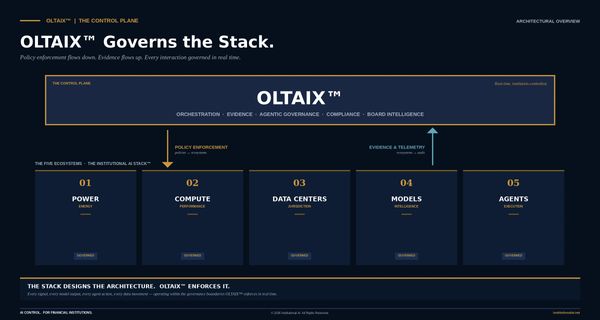
The Institutional AI Stack™ connects the five AI ecosystems — Power, Computing, Data Centers, Models, and Agentic Applications — under one governed architecture. OLTAIX™ governs it — enforcing policy, maintaining audit integrity, and providing real-time visibility across every layer simultaneously. Together they produce AI CONTROL — the condition of institutional AI governance in which every system is owned, governed, and under institutional command.

ENGAGE
Institutional AI accepts a limited number of new client engagements per quarter. Initial engagements begin with a confidential AI Sovereignty Assessment — complimentary for qualifying institutions.
AI IS A GIVEN. CONTROL IS NOT.