Architecture, not framework
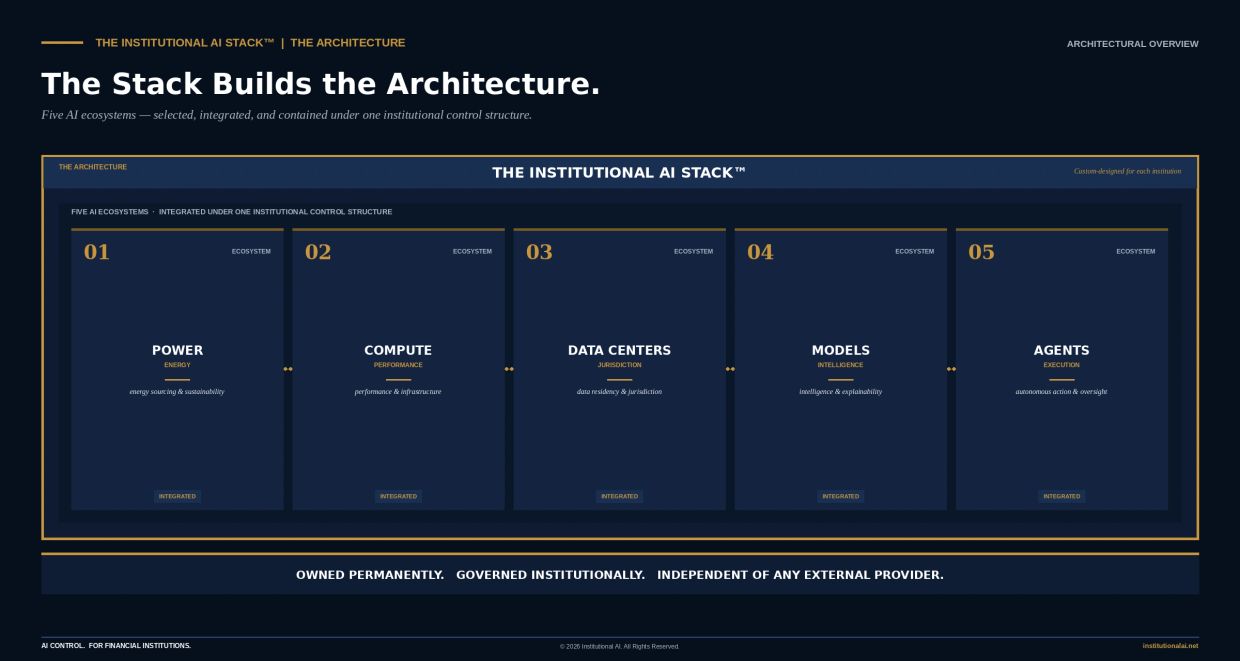
The distinction between an architecture and a framework is not semantic. A framework organizes thinking; an architecture organizes a system. The Institutional AI Stack™ is intended to describe the actual structure through which an institution exercises — or fails to exercise — authority over artificial intelligence, in a form specific enough to be evidenced and audited.
Its purpose is to make control locatable. When an institution cannot demonstrate control, the architecture identifies where the gap sits: in which ecosystem, along which pillar, at which point in the delegation chain. That precision is what allows control to move from assertion to evidence, and it is the property that distinguishes an institutional architecture from a statement of principle.
BUILT FOR REGULATED ENVIRONMENTS

Understanding the Institutional AI Stack™ starts with understanding what it is not.
It is not the global AI infrastructure — the power grids, GPU clusters, hyperscale data centers, and foundation models that the world's technology companies have built and that most institutions access through APIs and cloud contracts.
That global infrastructure exists. It is industrial in scale. It powers the AI most institutions use today. And it is controlled by a small number of providers whose terms, pricing, jurisdictional reach, and strategic priorities are not aligned with institutional fiduciary obligations.
The Institutional AI Stack™ is what sits between that global infrastructure and your institution — your controlled layer, selecting, integrating, and controlling the components of global AI infrastructure according to your regulatory requirements, risk tolerance, and objectives. Every layer customized. Every decision traceable.
The Stack runs deep — through all five ecosystems, from the power feeding a workload to the agent acting on its output. That depth is the subject of this page. Control also runs wide, across the managers, servicers, and providers an institution depends on — but that is a property of the engagement, not the architecture. The AI Control Assessment™ applies the Stack's structure across that chain; OLTAIX™ carries the control perimeter into it.
THE FIVE ECOSYSTEMS
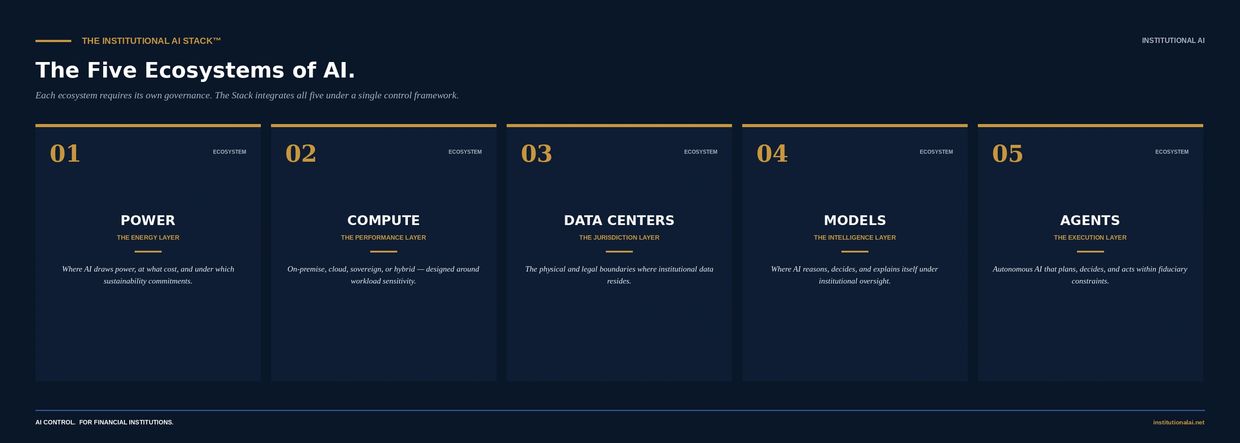
THE FIVE ECOSYSTEMS & AI CONTROL
The five ecosystems are the depth of the Stack. Each must be controlled in its own right; none, controlled alone, delivers control of the whole.

1. POWER — The Foundation Beneath the Stack
Why the ecosystem matters
Power is the electricity on which the entire stack depends, and it is the ecosystem in which institutions can least often demonstrate any command at all. It is easy to overlook precisely because it is foundational: attention gravitates to models and agents, while the energy that runs them is treated as a given. It is increasingly not a given. As AI workloads grow, the availability, cost, and continuity of power are emerging as material constraints on the scale and reliability of institutional AI.
How it bears on institutional control
An institution's command of the power ecosystem is a matter of continuity and siting. Whether power is owned, contracted, or drawn from the grid determines how exposed the institution's compute is to interruption. Where that power physically sits determines the jurisdiction and the energy law under which the institution's AI ultimately operates. In practice, almost no financial institution discloses command at this layer, which is itself a finding: the base of the stack is the least evidenced part of it.
Questions boards should ask
• Do we know the source and continuity of the power supplying the compute on which our critical AI depends?
• What happens to our AI operations under a sustained interruption of that supply?
• Where, jurisdictionally, does that power sit, and does it align with our data-residency obligations?
Implications for financial institutions
For most institutions, power will remain a delegated dependency rather than an owned asset. The control discipline at this layer is therefore contractual and operational: understanding the dependency, evidencing its continuity, and ensuring that a constraint at the base of the stack cannot silently propagate upward into the systems on which institutional judgment relies.
2. COMPUTE — The Engine of Intelligence
Why the ecosystem matters
Compute is the processing capacity on which models are trained and run — the graphics and tensor processors and specialized accelerators that perform the underlying computation. It matters because it is the ecosystem in which the distinction between ownership and rental becomes most concrete. An institution that owns its compute commands the engine of its intelligence directly; one that rents it holds that command only to the extent its contracts and its technical arrangements secure it.
How it bears on institutional control
Control over compute turns on ownership, isolation, and enforceable rights. Dedicated or owned compute confers a directness of command that rented capacity does not. Where capacity is shared, the logical and physical isolation of the institution's workloads from other tenants becomes the operative control. And because most institutions will rent rather than own, the contractual pillar — rights to audit, to exit, and to port workloads — carries much of the weight that ownership would otherwise carry.
Questions boards should ask
• Do we own, co-locate, or rent the compute on which our material AI runs, and do we understand the control implications of that choice?
• Where our compute is shared, how is the isolation of our workloads assured and evidenced?
• What are our contractual rights to audit and to exit, and could we exercise them without unacceptable disruption?
Implications for financial institutions
Compute is where ownership becomes visible in the public record; in our research it is one of only two infrastructure ecosystems in which any institution demonstrably reaches above non-disclosure, and it does so only where the institution owns rather than rents. For the majority that rent, demonstrable control means converting a commercial dependency into an evidenced and enforceable one.

3. DATA CENTERS — Where Intelligence Physically Resides
Why the ecosystem matters
Data centers are the facilities in which compute and data physically reside, whether owned, co-located, or arranged as a hybrid of on-premise and cloud environments. The ecosystem matters because it is where jurisdiction ceases to be an abstraction. The physical location of a data center determines the legal regime under which an institution's data and models are held, and therefore the enforceability of the institution's obligations concerning them.
How it bears on institutional control
Command of this ecosystem is expressed through data residency, storage control, and the orchestration that binds facilities together. A hybrid fabric that keeps compute, storage, and connectivity under institutional control — while permitting compliant elasticity where allowed — is the architectural form this command takes. The decisive test is provability: whether the institution can demonstrate, rather than assert, where its data resides and under whose jurisdiction it is governed.
Questions boards should ask
• Can we demonstrate, to a supervisor's satisfaction, where our institutional data and models physically reside?
• Does that location satisfy our data-residency and sovereignty obligations across every jurisdiction in which we operate?
• How is data held under control across the boundary between our own facilities and the cloud environments we use?
Implications for financial institutions
Data centers make jurisdictional control concrete, and jurisdiction is where several sectors' obligations bind most tightly. The institutions that command this ecosystem can prove the perimeter within which their intelligence operates; those that cannot are exposed at exactly the point where regulatory and fiduciary duties are most specific.
4. MODELS — THE INTELLIGENCE CORE
Why the ecosystem matters
Models are the systems that produce the institution's AI outputs — the machine-learning, deep-learning, and generative systems that generate the analysis on which decisions rest. This is the ecosystem in which, on the public record, control is most frequently demonstrated, and also the one in which it is most frequently over-claimed. The presence of a model platform is often presented as evidence of control; it is not. It is evidence of capability.
How it bears on institutional control
Control at the model layer rests on a named, auditable mechanism: a registration and validation discipline under which no model enters production without being recorded, evaluated, and made subject to ongoing oversight. Bias testing, explainability, and lineage support that discipline; isolation of proprietary data from external models protects it. The distinction that determines the tier is whether such a mechanism is named and evidenced, or merely implied by the existence of a platform.
Questions boards should ask
• Is there a mechanism that prevents any model from entering production without registration, validation, and ongoing monitoring?
• Can we evidence that mechanism to an auditor, as distinct from describing a platform or a policy?
• How is our proprietary data prevented from being absorbed into external models we do not control?
Implications for financial institutions
Because the model layer is where capability is most visible, it is also where the gap between capability and control is most consequential. The institutions that lead disclose the mechanism, not the platform. This is the ecosystem in which the whole discipline's central distinction — intent versus evidence — is most often tested.
See our position on Open Weights and American AI Leadership
5. AGENTS — Intelligence That Acts
Why the ecosystem matters
Agents are AI systems that act on decisions rather than merely informing them — planning, sequencing, and executing multi-step tasks with a degree of autonomy. This is the newest ecosystem and the one in which demonstrable, governed control is rarest. Agentic activity is expanding quickly; the disclosed capacity to bound, monitor, and evidence that activity in production is expanding more slowly.
How it bears on institutional control
Control over agents is a matter of bounded autonomy, human oversight, and traceability. The operative mechanisms are the envelope within which an agent is permitted to act and the limits beyond which it may not, the human-in-the-loop workflows that keep consequential decisions subject to approval, and the observability that renders every agentic action traceable to a mandate or policy. Where agents recommend and humans decide, control is preserved; where agents act autonomously without an evidenced boundary, it is at risk.
Questions boards should ask
• Where in our operations do AI agents take action rather than make recommendations, and are those boundaries defined and enforced?
• For consequential actions, is a human accountable at the point of decision?
• Can every agentic action be traced to an authorizing mandate or policy?
Implications for financial institutions
Agents are the ecosystem in which capability most outruns control. In our research, demonstrated control at this layer is the rarest of all; extensive agentic activity coexists with little evidence of governed production. As autonomous systems move further into operational processes, the capacity to bound and evidence their behavior will become one of the defining tests of institutional AI control.
THE FIVE PILLARS OF CONTROL
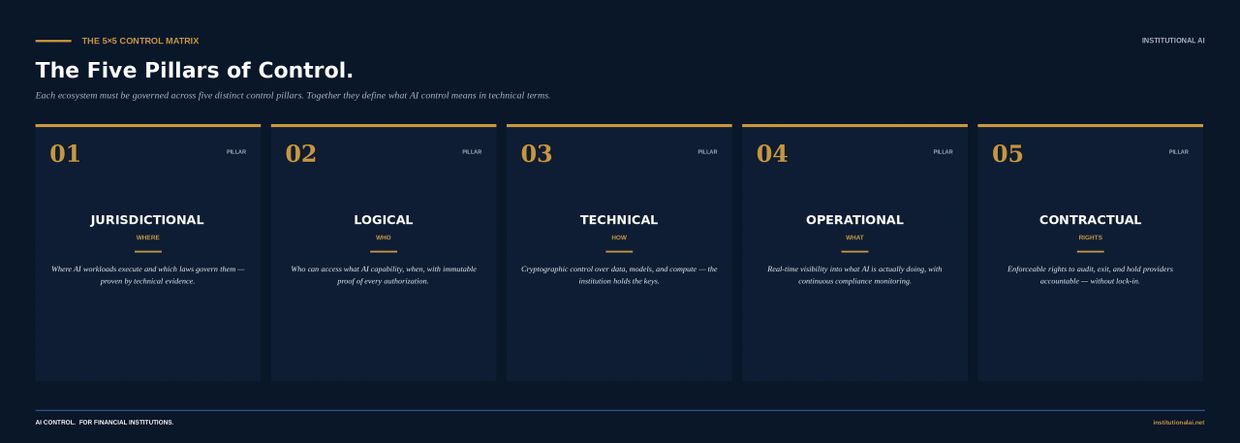
Each ecosystem is commanded, or ceded, through the same five pillars.
Jurisdictional control concerns where workloads run and under whose law. Logical control concerns who may access what, and on what terms. Technical control concerns cryptographic and isolation command over data and models. Operational control concerns real-time visibility into what is actually happening. Contractual control concerns enforceable rights to audit, exit, and hold providers accountable.
Reading control through these pillars, rather than as a single measure, is deliberate. An institution may hold strong contractual rights over a system while lacking operational visibility into it, or command a model technically while having no jurisdictional certainty about where it executes. A single summary judgment would conceal exactly the asymmetries that determine where an institution is exposed. The architecture is therefore read cell by cell and is never reduced to one figure.
OLTAIX™ — The Control Fabric
.png/:/rs=w:1240,cg:true,m)
The five ecosystems of the Institutional AI Stack™ do not self-control. They require a layer that enforces policy, monitors compliance, maintains audit integrity, and provides real-time visibility across every ecosystem at once. That layer is OLTAIX™ — the Institutional AI Control Fabric.
OLTAIX™ does not sit alongside the Stack; it operates it. It enforces the five pillars of control — Jurisdictional, Logical, Technical, Operational, Contractual — down through all five ecosystems, and reads evidence back up: every model output, every agent action, every data movement, traceable in real time. Twenty-five cells, enforced continuously. And it reaches: where the Stack extends into a delegate's infrastructure, OLTAIX™ is built to carry the control perimeter with it.
The Stack is the architecture. OLTAIX™ is the control fabric that operates it — deep, across all five ecosystems, and wide, across the chain your institution depends on.
WHAT AI CONTROL LOOKS LIKE / ILLUSTRATIVE SCENARIOS
(Illustrative)
Before the Stack:
A global custodian deploys AI-driven reconciliation agents across multi-custodian positions, cash, and corporate actions, processing client portfolio data through external models under standard API terms, with logs held in vendor systems.
A sovereign wealth fund client, conducting its annual service-provider review, asks the custodian to demonstrate that every AI action affecting its portfolio data over the past 12 months is documented and auditable. The custodian cannot produce those records from systems it controls — and the sovereign wealth fund, for its part, has no way to verify the AI behind the numbers it has been booking all year. The fund begins an RFP process.
After the Stack:
The same reconciliation agents operate under OLTAIX™ control, logging every action affecting client portfolio data to institution-controlled systems — and emitting verifiable provenance the client's own control plane can check. The custodian answers the annual review within hours, from records it owns. The sovereign wealth fund can now verify, rather than assume, the provenance of the valuations it books. The client does not initiate an RFP. Control demonstrated down the chain becomes a retention tool for the servicer and a fiduciary instrument for the owner.
(Illustrative)
Before the Stack:
A large asset manager submits investment research queries to an external AI model. The provider processes those queries — containing proprietary strategy logic and portfolio positioning — in plaintext on its own infrastructure, logs the interactions in its own systems, and governs the data under standard API terms. The asset manager's competitive intelligence is technically accessible to the provider by design.
After the Stack:
The same investment research AI runs on institution-controlled infrastructure under HYOK encryption. Model inference executes within confidential computing boundaries — the provider cannot access the data during processing. Every interaction is logged in the institution's own SIEM. The competitive intelligence is technically protected, not just contractually promised.
(Illustrative)
Before the Stack:
A large retirement plan provider deploys AI for compliance testing and participant engagement. Participant Social Security numbers are processed by an external model under standard API terms — in plaintext, on provider infrastructure, with interaction logs in the vendor's systems. A DOL examination requests records of all AI actions affecting participant data over the past 18 months. The compliance team cannot produce them from systems it controls. The examination finding notes incomplete documentation.
After the Stack:
The same AI operates on institution-controlled infrastructure under HYOK encryption. Every interaction is logged in real time to institution-controlled systems. The DOL examination request is answered within 48 hours — a complete evidence package produced from records the institution owns. No examination finding. The AI control is demonstrated, not asserted.
THE AI CONTROL ASSESSMENT IS WHERE IT STARTS

Before building the Stack, an institution needs to see where its control posture stands across all five ecosystems. The AI Control Assessment™ applies the 5×5 Control Matrix™ — the five pillars against each of the five ecosystems — across twenty-five intersections, placing each on a five-tier scale and identifying exactly where control is evidenced, assumed, or absent, and where investment changes the most.
This is also where control runs wide: the Assessment maps the institution's delegation chain and applies the same instrument to each material relationship — a matrix for the institution, and one for every party its operations rest on.
The Stack is built around what the Assessment reveals. The Assessment makes the gaps visible — deep and wide. The Stack closes them; OLTAIX™ holds them closed.