AI CONTROL GAP
What the RESEARCH shows
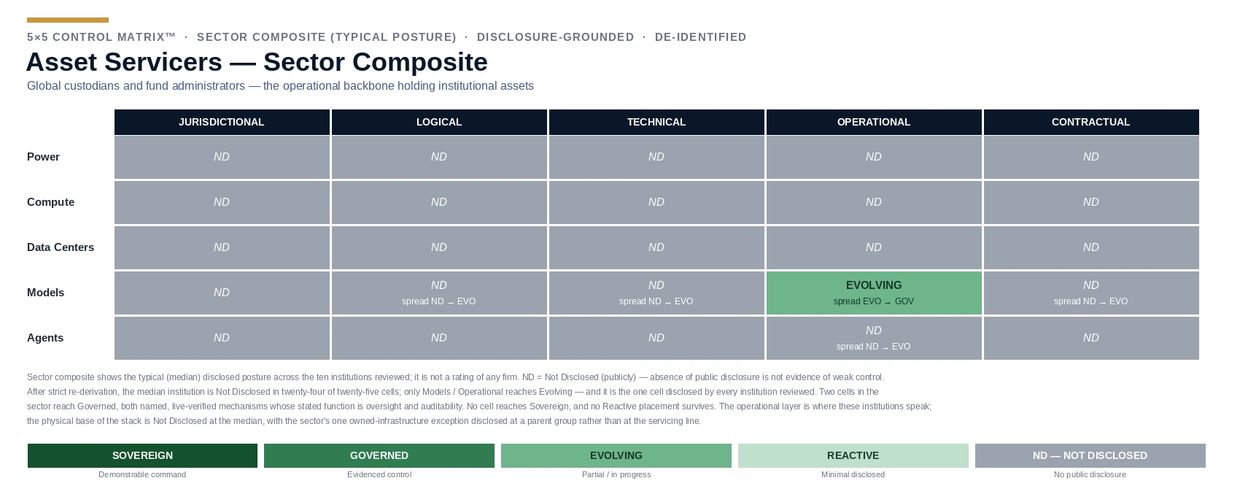
Servicers cluster at an evolving posture on the model layer at the typical level, with the strongest firms reaching evidenced control in how models are operated and the rest disclosing named tools without a corresponding control mechanism.
The sector illustrates a distinction this report draws throughout: a named platform or deployed application is a capability, not in itself a control mechanism, and the tier turns on whether an auditable control mechanism is disclosed around it.
Agentic operation across the category is disclosed at an evolving stage at most — frequently in development or pilot — rather than in governed production.

THE CLIENT GOVERNANCE CASCADE
Asset servicers occupy a unique position in the financial ecosystem: they are the infrastructure layer. Institutional clients — asset managers, pension funds, sovereign wealth funds, insurance companies — depend on asset servicer operations as the foundation of their own governance.
When asset servicer AI systems process client portfolio data, calculate NAVs, execute corporate actions, and generate regulatory reporting, the governance of those AI systems is not just the firm's obligation. It is a link in every client's fiduciary chain.
If the AI systems performing custody, fund administration, and transfer agency operations are running on infrastructure the firm cannot audit, in jurisdictions the firm cannot verify, under terms the firm has not negotiated for AI-specific processing — clients' governance depends on assurances the firm cannot independently confirm.
The asset servicer that can demonstrate AI Control to its clients is positioned differently than the asset servicer that can only assure them. Sophisticated institutional clients are beginning to ask. The first asset servicers to answer with verifiable governance — not contractual promises — are setting the standard the rest of the industry will follow.
FIVE QUESTIONS FOR THE BOARD
- Can we prove where AI processing occurred, who had access, and what controls governed it when AI touches NAVs, positions, corporate actions, or client data?
- If a critical AI or cloud provider failed, could we continue core servicing operations without losing control, visibility, or client service?
- Can we reconstruct an AI-influenced operational decision months later and produce the evidence quickly for a client, auditor, or regulator?
- Do our clients understand where AI is acting on their data and processes — and can we demonstrate the controls surrounding that activity?
- Across every jurisdiction in which we operate, can we evidence that AI remains within defined legal, operational, and contractual bounds?
THE ASSET SERVICING AI CONTROL CHALLENGE

Custodians & Global Custody Banks
Their Mandate: Safeguard client assets, settle transactions, and produce accurate records across multiple markets, currencies, and regulatory jurisdictions simultaneously.
Core Challenges:
- Client governance cascade → Institutional clients — pension funds, sovereign wealth funds, asset managers — are beginning to impose AI governance requirements on their custodians. Your AI posture must satisfy not just your own regulators but the governance standards of your most demanding clients.
- Data residency at operational scale → Custody operations process client data across dozens of jurisdictions. AI models processing that data create cross-border transfer exposures that standard data center governance does not address — and that DORA and EU AI Act obligations make increasingly difficult to ignore.
- Operational resilience under DORA → The Digital Operational Resilience Act creates explicit obligations around ICT third-party risk management. AI infrastructure providers are ICT third parties. Most custody bank AI vendor agreements do not satisfy DORA's contractual requirements for audit rights, exit provisions, and concentration risk management.
Fund Administrators
Their Mandate: Calculate NAVs, process investor transactions, maintain fund records, and produce regulatory filings with accuracy that cannot be questioned.
Core Challenges:
- NAV accuracy liability → AI-assisted NAV calculation and pricing validation creates a new category of operational risk. Errors due to model drift or data quality failures that go undetected create liability that flows directly to the administrator — and through the administrator to the fund's investors and directors.
- Regulatory reporting defensibility → AI-generated regulatory filings — AIFMD, UCITS, Form PF, FATCA — carry identical accuracy obligations to manually produced ones. The audit trail requirements for AI-assisted regulatory submissions are the same as for human-prepared ones. Most fund administrator AI systems cannot produce those trails on demand.
- Client data sovereignty → Fund administrators aggregate investor data — KYC records, subscription documents, beneficial ownership information — across multiple fund structures and jurisdictions. AI processing of that data under standard vendor terms creates data residency and privacy obligations that most administrator agreements do not address.
Transfer Agents
Their Mandate: Maintain shareholder records, process subscription and redemption transactions, manage investor communications, and administer distributions with complete accuracy.
Core Challenges:
- Investor data protection → Transfer agents hold some of the most sensitive investor identification data in the financial system — passport copies, tax residency declarations, beneficial ownership structures. AI systems processing this data under standard API terms are processing it on third-party infrastructure without the technical controls that investor data sensitivity requires.
- AML/KYC AI governance → AI-driven AML screening and KYC refresh workflows create regulatory obligations around model explainability, decision audit trails, and adverse action documentation. The governance framework around those AI systems must satisfy the same standard as the compliance function they are performing.
- T+1 settlement pressure → Compressed settlement cycles create operational urgency that is pushing AI automation into transfer agency workflows faster than governance frameworks are being built around them. Speed of automation without governance is operational risk accumulating silently.
Securities Services Providers
Their Mandate: Deliver integrated post-trade services — custody, fund administration, collateral management, securities lending — across complex multi-asset, multi-jurisdiction client relationships.
Core Challenges:
- Concentration risk across the AI stack → Large securities services firms often rely on one or two major cloud providers for AI workloads spanning multiple service lines and client types. A single provider disruption or contractual restriction creates simultaneous operational exposure across custody, fund administration, and reporting functions .
- Cross-service data governance → AI systems that access data across service lines — using custody data to inform fund administration, using transfer agency data to inform collateral management — create data governance complexity that no single vendor agreement was designed to address.
- Client due diligence escalation → Sophisticated institutional clients are beginning to include AI governance in their annual service provider reviews. Securities services firms that cannot demonstrate matrix-level governance across their AI stack are entering a competitive disadvantage that will compound as AI governance due diligence becomes standard.
ASSET SERVICERS — AI USE CASES
OPERATIONAL RISK & RESILIENCE
Control the operation before it controls you
Use Cases
- Real-time operational risk monitoring across all processing workflows
- AI-driven SLA prediction and breach prevention
- Cyber threat detection across client data environments
- Business continuity scenario modeling and stress testing
Value Creation
- Proactive risk mitigation before client impact
- Reduced operational losses from processing failures
- Institutional-grade resilience posture for regulatory and client scrutiny
Tie to Stack
- OLTAIX™ → policy enforcement, anomaly detection, and real-time intervention
- Models → predictive risk intelligence across operational workflows
DATA GOVERNANCE & LINEAGE
Know where every number came from
Use Cases
- End-to-end data lineage tracking across systems and counterparties
- Master data management and golden record construction
- Data quality monitoring with AI anomaly detection
- Jurisdictional data residency enforcement across client mandates
Value Creation
- Single source of truth across the servicing operation
- Demonstrable data sovereignty for regulatory and client purposes
- Elimination of data provenance gaps in audit scenarios
Governance Reality CheckData lineage is the foundation of every regulatory audit, every client dispute, and every operational investigation. AI systems that process data without producing institution-controlled lineage records create gaps that cannot be closed retrospectively.
Tie to Stack
- Data Centers + Models → governed data fabric with complete lineage
- OLTAIX™ → real-time lineage visibility and residency enforcement
RECONCILIATION & EXCEPTION MANAGEMENT
From manual resolution → governed automation
Use Cases
- AI-driven multi-custodian reconciliation across positions, cash, and corporate actions
- Automated exception identification, classification, and resolution routing
- Real-time break detection with root cause intelligence
- Cross-counterparty discrepancy analysis and escalation
Value Creation
- Dramatic reduction in manual reconciliation effort
- Faster break resolution cycles
- Reduced operational risk and client SLA exposure
Governance Reality CheckReconciliation agents that autonomously identify, classify, and route exceptions are performing operational functions that carry institutional liability. Every agent action must be traceable to a defensible, auditable record. Most asset servicer AI deployments route exceptions through vendor systems — the audit trail lives in someone else's infrastructure.
Tie to Stack
- Agentic Applications → autonomous reconciliation agents operating under fiduciary logic
- OLTAIX™ → governs every agent action with complete audit trail in institution-controlled systems
CORPORATE ACTIONS PROCESSING
Zero tolerance for error, at any volume
Use Cases
- Automated corporate action event detection and classification
- AI-driven entitlement calculation across complex securities
- Deadline monitoring and instruction routing
- Client notification and election management automation
Value Creation
- Elimination of manual processing risk on time-critical events
- Full audit trail on every entitlement decision
- Scalability across high-volume periods without operational strain
Governance Reality CheckCorporate action errors have direct financial consequences for clients and create liability that flows back to the servicer. AI entitlement calculations must be explainable and auditable to the same standard as manual ones. They almost never are.
Tie to Stack
- Models → event classification and entitlement intelligence
- Agentic Applications + OLTAIX™ → governed execution with explainable, institution-controlled outputs
REGULATORY REPORTING & COMPLIANCE
Turn reporting from a burden into a control advantage
Use Cases
- Automated generation of regulatory reports — CFTC, SEC, EMIR, MiFID II, DORA
- Real-time compliance monitoring across client portfolios
- AI-driven audit trail construction for regulatory examinations
- Exception-based compliance alerting and escalation
Value Creation
- Reduced cost of compliance operations
- Faster, more accurate regulatory submissions
- Defensible audit trails on demand
Industry SignalDORA's full enforcement creates explicit AI governance obligations for EU-facing asset servicers. ICT third-party risk management requirements extend to AI infrastructure providers. Most AI vendor agreements in use today do not satisfy DORA's contractual standards for audit rights, exit provisions, and concentration risk disclosure.
Tie to Stack
- Models + Data Centers → governed data ingestion and compliance intelligence
- OLTAIX™ → policy enforcement and continuous regulatory alignment
CLIENT REPORTING & TRANSPARENCY
Reporting that explains itself
Use Cases
- AI-generated client reports with natural language explanation
- Real-time performance attribution and portfolio analytics
- Customized reporting across client tiers and mandates
- Data quality monitoring and anomaly detection in client outputs
Value Creation
- Stronger client confidence through explainable outputs
- Reduced manual report production effort
- Differentiated service quality through real-time transparency
Industry Signal
Large institutional clients are beginning to require that service providers demonstrate AI governance across every client-facing output. The first asset servicer to offer real-time AI governance transparency as a standard service feature will set the standard others must match.
Tie to Stack
- Agentic Applications → automated report generation under governance
- OLTAIX™ → ensures data integrity and consistency across all client outputs
Red Flags — When Control Should Come First
AI remains supplementary to operations
If AI is limited largely to internal productivity, control investment should remain proportionate. Prioritize the systems that touch clients, assets, transactions, and regulated processes first.
A major platform migration is underway
Build AI control into the target architecture rather than the environment being replaced. Control designed around the current platform may not survive the transition.
AI operating capability is still limited
Build the control capability before committing to more complex infrastructure. Use external specialists where needed while developing the internal expertise required to operate and evidence control over time.
Green Flags — When to Accelerate
Regulatory requirements are tightening
Where AI supports material operational or technology processes, control should be built into the institution’s broader resilience and risk framework.
Action: Use the Matrix to evidence where control exists and where additional work is required.
Client due diligence is asking about AI
Institutional clients are beginning to ask more specific questions about AI use, data protection, oversight, and third-party dependencies.
Action: Be prepared to demonstrate the control position with evidence, not policy alone.
Supervisors are asking about AI use
Regulatory attention to AI in banking and servicing environments is increasing as adoption expands.
Action: Establish the control framework before examination questions become more detailed.
Peers are investing in AI capability
Across the servicer market, firms are expanding AI-enabled operations, analytics, and automation.
Action: Differentiate through demonstrated control, not deployment alone.
AI is becoming operationally critical
As AI becomes embedded in settlement, servicing, reconciliation, and other time-sensitive processes, failure becomes an operational-resilience issue.
Action: Treat AI control as part of core operational control, not as a separate technology initiative.
REQUEST The State of AI Control in Institutional Finance
AVAILABLE ON A RELATIONSHIP BASIS TO QUALIFYING INSTITUTIONS
All engagements and discussions are conducted under confidentiality protections, including NDA where applicable. Control Tiers represent Institutional AI’s analytical interpretation of public disclosure completeness and are not assessments, audits, or certifications of any institution’s actual control environment.
AI is a given. Control is not.™
101 Federal Street, Boston, MA, USA
