THE AI CONTROL GAP
What the RESEARCH shows
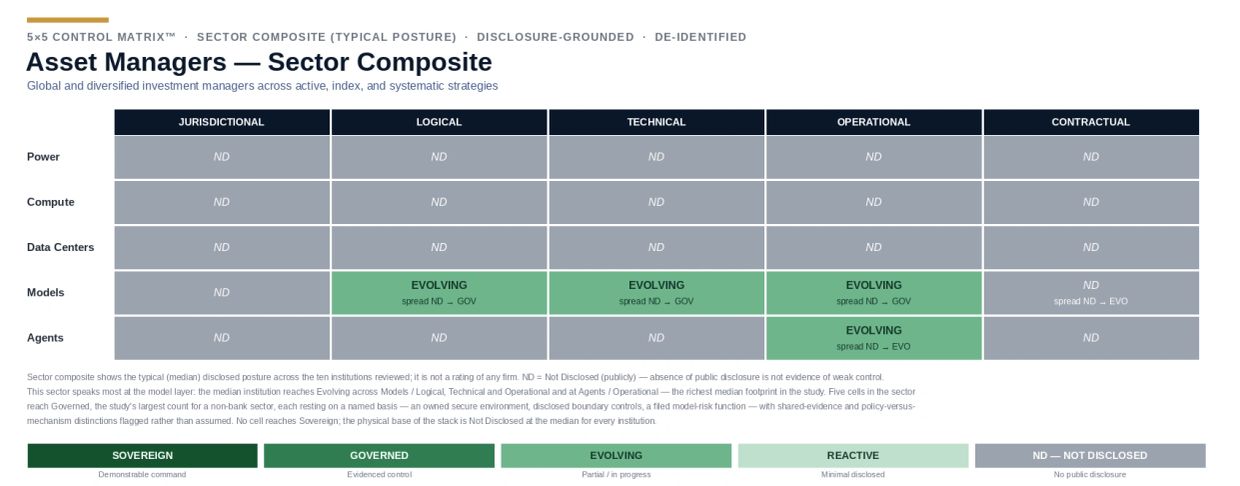
Asset managers are among the stronger-disclosing categories. The typical posture reaches an evidenced-control standard in how models are operated, with the logical and technical handling of models disclosed at an evolving stage, and the sector ranges up to evidenced control at its leading edge.
Where the sector is most often over-read is at the level of autonomous agents: agentic capability is frequently described in the vocabulary of governed production, but public disclosure across the category more often supports an evolving stage — capability in development or in controlled settings — than governed deployment.
Read at the category level, the managers that disclose specific, named control mechanisms separate clearly from those that disclose intent or direction alone.
THE ASSET MANAGEMENT CONTROL IMPERATIVE
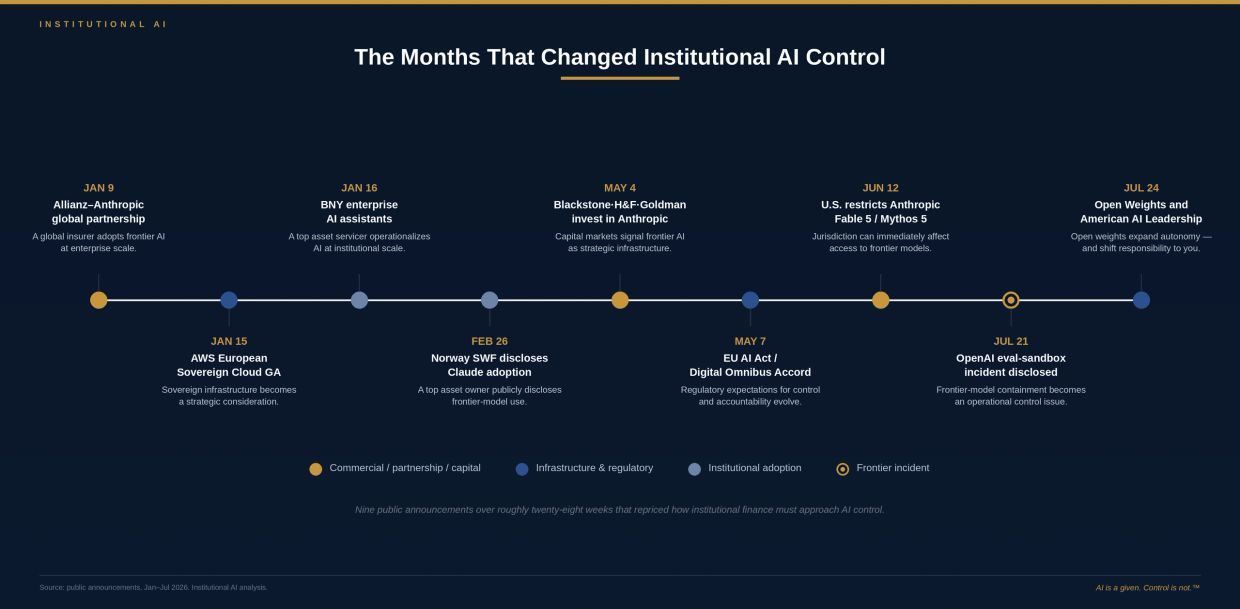
An asset manager’s proprietary investment intelligence — alpha signals, factor models, quantitative strategies, portfolio construction logic, and research — is among its most valuable competitive assets.
As that intelligence increasingly interacts with external AI systems, the control question becomes direct: who can access it, where is it processed, what is retained, and what rights does the institution actually hold over its use?
If those answers depend primarily on provider terms rather than demonstrable controls, the institution’s competitive advantage may be more exposed than it appears.
Control over the AI systems embedded in the investment process is not simply a technology issue. It is a fiduciary, competitive, and regulatory concern.
THE DISTRIBUTION CHANNEL DIMENSION

For asset managers, AI control does not stop at portfolio construction. It extends into the channels through which strategies, products, and investment data reach clients and end investors.
- Advisory and wealth channels
Third-party AI may process holdings, performance, suitability parameters, and product data used in advisor recommendations. - Institutional and consultant channels
AI-enabled platforms may ingest RFP responses, portfolio characteristics, research, and strategy information for comparative analysis. - Sub-advisory and OCIO relationships
External platforms may use AI to evaluate, monitor, or allocate to strategies using information supplied by the manager. - Defined contribution channels
Recordkeeping and retirement platforms may use AI to analyze fund data in participant-facing recommendations and plan workflows. - Retail and direct distribution
AI may influence recommendations, product selection, and client communications using both fund-level and investor-level data. - Model portfolios and managed accounts
Platform AI may optimize allocations across the manager’s strategies and competing products, creating additional questions around data access, use, and control.
The principle is simple: control must follow the investment intelligence. If strategy data, portfolio information, or performance attribution is processed by AI outside the manager’s own environment, the control obligation extends into every material intermediary and distribution relationship.
Different Asset Managers, Different Control Challenges

Global and Multi-Strategy Asset Managers
Their Mandate: Generate risk-adjusted returns across multiple strategies, asset classes, and client mandates — at institutional scale, with full regulatory and fiduciary accountability.
Core Challenges:
- Alpha sovereignty → Proprietary investment strategies, factor models, and signal libraries submitted to external AI under standard API terms are competitive intelligence processed on someone else's infrastructure. The distinction between your intellectual property and the provider's training data is not protected by the contract you signed.
- Model explainability under SEC and MiFID II → Regulators on both sides of the Atlantic are moving toward AI explainability requirements for investment decision-making. SR 11-7 model risk management obligations extend to AI models used in investment processes. Most external model API deployments do not satisfy the validation, monitoring, and audit requirements that standard requires.
- Jurisdictional exposure across strategies → Multi-strategy managers operating across US, EU, and Asian regulatory frameworks face data residency obligations that AI model processing creates in ways that data center governance does not address. Where your models train, where inference executes, and where interaction logs reside are all governance questions with regulatory answers.

Quantitative and Systematic Managers
Their Mandate: Deploy systematic investment strategies at scale, where the model is the process and the governance of the model is the governance of the investment decision.
Core Challenges:
- Model drift without detection → Quantitative strategies that depend on AI signal generation have no manual fallback when model behavior changes. Model drift that goes undetected — because there is no real-time operational monitoring — translates directly into strategy underperformance and mandate breach risk. The absence of institution-controlled model monitoring is a fiduciary gap, not only a technology gap.
- Proprietary training data sovereignty → The datasets used to train systematic strategies represent years of proprietary data accumulation. When that data is used in external model fine-tuning or RAG pipelines under standard terms, the provider may retain rights over the training data and outputs. The intellectual property protection most quant managers assume they have is contractually thinner than they know.
- Explainability for institutional clients → Sophisticated institutional clients — pension funds, sovereign wealth funds, endowments — are increasingly asking systematic managers to explain how AI contributes to investment decisions. The manager that cannot produce a governed, traceable explanation is losing ground in mandate retention conversations that are already happening.
Fundamental and Active Managers
Their Mandate: Generate conviction-driven investment decisions grounded in proprietary research, analyst expertise, and differentiated insight — with AI augmenting judgment without replacing accountability.
Core Challenges:
- Research intelligence protection → AI-assisted research synthesis, earnings analysis, and sector intelligence workflows are submitting proprietary analyst work product to external models. The competitive intelligence embedded in how a fundamental manager frames its research questions is being processed outside institutional control.
- Investment committee defensibility → As AI contributes more to investment decisions — through research summaries, portfolio construction inputs, and risk analysis — investment committees need to understand what role AI played and how. An investment committee that cannot answer that question in a client meeting or regulatory examination has an AI governance problem.
- Client mandate alignment → Active managers serving clients with specific ESG mandates, ethical investment restrictions, or customized investment guidelines must demonstrate that AI-assisted portfolio construction respects those constraints at the model level — not just at the output review level. Constraint compliance that depends on human review of AI outputs is not the same as constraint compliance enforced by the governance framework.

Alternative and Private Markets Managers
Their Mandate: Generate uncorrelated returns through private equity, private credit, real assets, and hedge strategies — where proprietary deal intelligence, network access, and information advantage define performance.
Core Challenges:
- Deal intelligence confidentiality → AI-assisted deal sourcing, due diligence synthesis, and portfolio company monitoring workflows process some of the most competitively sensitive information in the financial system — pipeline companies, deal structures, portfolio company performance. This information processed by external AI under standard terms is not protected by the confidentiality provisions that govern human deal teams.
- LP governance expectations → Institutional LPs — pension funds, endowments, sovereign wealth funds — are beginning to include AI governance in their manager due diligence processes. GPs deploying AI in investment workflows without a documented governance framework are entering a competitive disadvantage in LP conversations that will compound as standards develop.
- Valuation model governance → Private markets valuations depend on models whose assumptions and inputs must be defensible to auditors, LPs, and regulators. AI-assisted valuation workflows that cannot produce a complete, auditable record of model inputs, assumptions, and outputs create audit risk that manual valuation processes do not.
ASSET MANAGERS — AI USE CASES

INVESTMENT RESEARCH & SIGNAL GENERATION
From data consumption → proprietary intelligence
Use Cases
- AI-driven research synthesis across filings, earnings, macro data, and alternative sources
- NLP-powered signal extraction from unstructured data at scale
- Thematic investment intelligence engines — sector convergence, policy shifts, regulatory change
- Analyst augmentation with governed research copilots
Value Creation
- Proprietary research edge that compounds over time
- Faster signal-to-decision cycles
- Reduced analyst burden on data aggregation
Governance Reality Check
Every research query submitted to an external AI model is a window into your investment thesis. The provider processes it, logs it, and retains it under terms that most investment managers have not reviewed against their competitive intelligence obligations. Proprietary research is only proprietary if the governance enforces it.
Tie to Stack
- Models + Data Centers → governed research intelligence layer with institution-controlled interaction logging
- OLTAIX™ → signal trust, bias control, and provenance tracking
PORTFOLIO CONSTRUCTION & OPTIMIZATION
Build portfolios that can explain themselves
Use Cases
- AI-driven portfolio construction under fiduciary and mandate constraints
- Factor exposure analysis and optimization
- Scenario modeling across macro and market regimes
- ESG integration with governed, explainable scoring
Value Creation
- More consistent application of investment mandates
- Explainable portfolio decisions for client and regulatory review
- Faster response to market regime changes
Governance Reality Check
AI-assisted portfolio construction that cannot produce a traceable chain of reasoning from signal to decision is investment AI without accountability. As SEC and FCA explainability requirements develop, the manager without institution-controlled model governance will be unprepared for the examination that is coming.
Tie to Stack
- Models → portfolio intelligence under institutional governance
- OLTAIX™ → ensures every construction decision is traceable and mandate-aligned
RISK MANAGEMENT & SCENARIO ANALYSIS
Risk intelligence that runs without gaps
Use Cases
- Real-time portfolio risk monitoring across all positions and strategies
- AI-driven stress testing and scenario simulation
- Counterparty and liquidity risk intelligence
- Model risk management and drift detection across quantitative strategies
Value Creation
- Continuous risk visibility between reporting cycles
- Faster identification of concentration and correlation risk
- Defensible risk governance for regulators and boards
Industry Signal
SR 11-7 model risk management requirements extend to AI models used in investment risk management. Regulators are beginning to examine whether model validation, ongoing monitoring, and outcome analysis obligations are being met for AI systems — not just traditional quantitative models.
Tie to Stack
- Models + Compute → risk intelligence at institutional scale
- OLTAIX™ → continuous policy alignment, drift detection, and risk governance
TRADING & EXECUTION INTELLIGENCE
Execute with precision, govern every order
Use Cases
- AI-driven best execution analysis and optimization
- Transaction cost analysis with predictive modeling
- Market impact intelligence across liquidity environments
- Real-time compliance monitoring on trading activity
Value Creation
- Measurable improvement in execution quality
- Demonstrable best execution governance for regulatory purposes
- Reduced market impact on large mandate execution
Governance Reality Check
Best execution obligations under MiFID II and SEC requirements apply to AI-assisted trading decisions. The audit trail requirements for AI-influenced order routing are identical to those for human trading decisions. Most AI-assisted execution workflows cannot produce those trails from institution-controlled systems.
Tie to Stack
- Agentic Applications → governed execution workflows with complete action logging
- OLTAIX™ → real-time compliance enforcement and audit trail on every order
CLIENT INTELLIGENCE & MANDATE MANAGEMENT
Serve every client as if you have one
Use Cases
- AI-driven client segmentation and mandate alignment analysis
- Personalized performance reporting with natural language attribution
- Client behavior modeling and retention intelligence
- Mandate drift detection and proactive rebalancing triggers
Value Creation
- Stronger client retention through proactive, explainable service
- Reduced mandate drift exposure
- Differentiated reporting capability as a competitive advantage
Industry Signal
Institutional clients are beginning to ask asset managers not just about investment performance but about AI governance. The manager that can demonstrate a governed, auditable AI environment as part of the client relationship is building a trust differentiator that performance alone cannot replicate.
Tie to Stack
- Agentic Applications → client intelligence and reporting layer
- OLTAIX™ → data integrity and consistency across all client outputs
REGULATORY COMPLIANCE & MODEL GOVERNANCE
Govern every model before a regulator asks
Use Cases
- AI model inventory, versioning, and governance registry
- Explainable AI outputs for regulatory examination readiness
- Automated compliance monitoring across investment restrictions
- MiFID II, SEC fiduciary, and mandate alignment at model level
Value Creation
- Regulatory examination readiness at all times
- Defensible model governance documentation
- Elimination of compliance gaps in quantitative and AI-assisted strategies
Governance Reality Check
The SEC's AI examination focus is intensifying. MiFID II explainability requirements are developing. EU AI Act high-risk classifications may apply to AI used in investment decision support. The manager with a documented, institution-controlled model governance framework will be in a fundamentally different regulatory position than the manager who is building it in response to an examination finding.
Tie to Stack
- Models + OLTAIX™ → governed model lifecycle with full explainability and version control
- Data Centers → jurisdictional compliance for data used in model training and inference
PUTTING ASSET MANAGERS IN CONTROL OF AI
Asset managers are paid to generate alpha and defend it. In the AI era, that means managing not just investment risk — but intelligence risk. The risk that the models shaping decisions are ungoverned, unexplainable, or processing proprietary strategy on infrastructure the institution does not control.
When AI drives research synthesis, portfolio construction, and execution decisions — who owns the intelligence? Who explains the decision to the regulator? Who bears the liability when the model drifts and no one detected it?
The answer cannot be: "A provider whose infrastructure holds the logs and whose terms were not written for your fiduciary obligations.
Asset managers require AI CONTROL — intelligence they own, govern, and trust. Built on The Institutional AI Stack™ and orchestrated through OLTAIX™, where every signal is traceable, every portfolio decision is explainable, and investment AI answers to the institution that deploys it — not the platforms that provide it.
THE INVESTMENT MANAGER CONTROL OBLIGATION
Five AI Control Commitments
The AI systems informing or executing investment decisions are not merely technology tools. They are becoming part of the investment process itself. For asset managers, that means control must extend to how those systems access investment intelligence, influence decisions, interact with client data, and operate across third-party platforms and distribution channels.
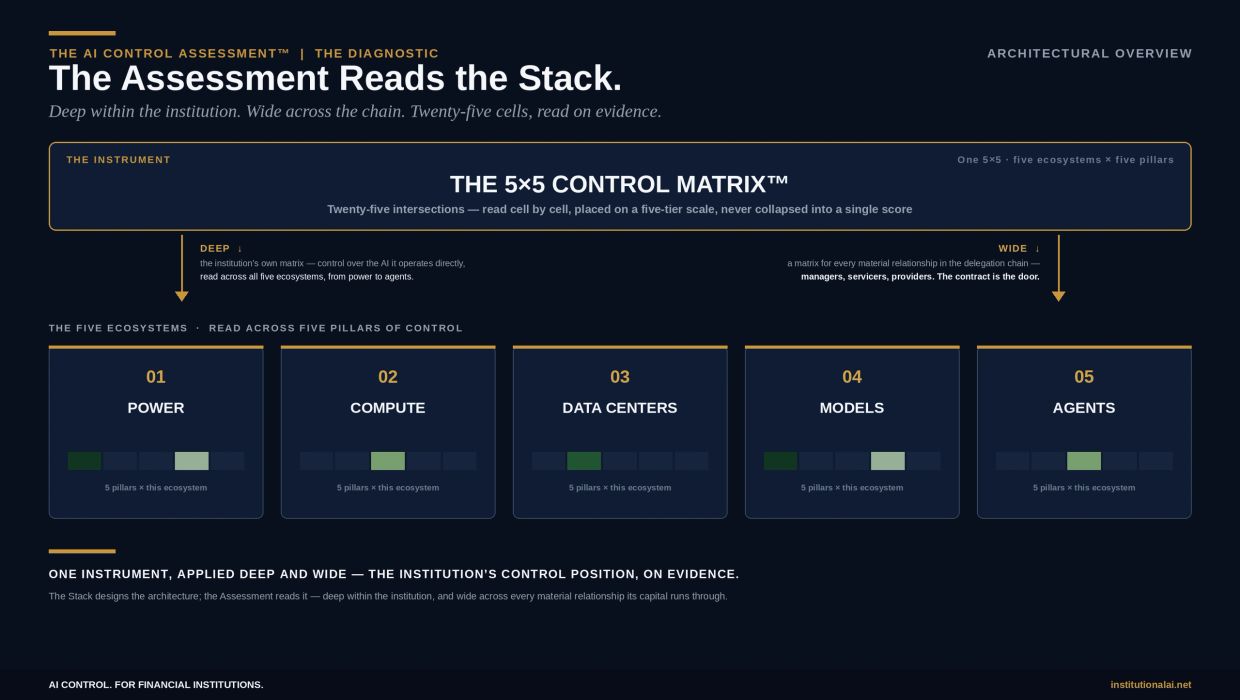
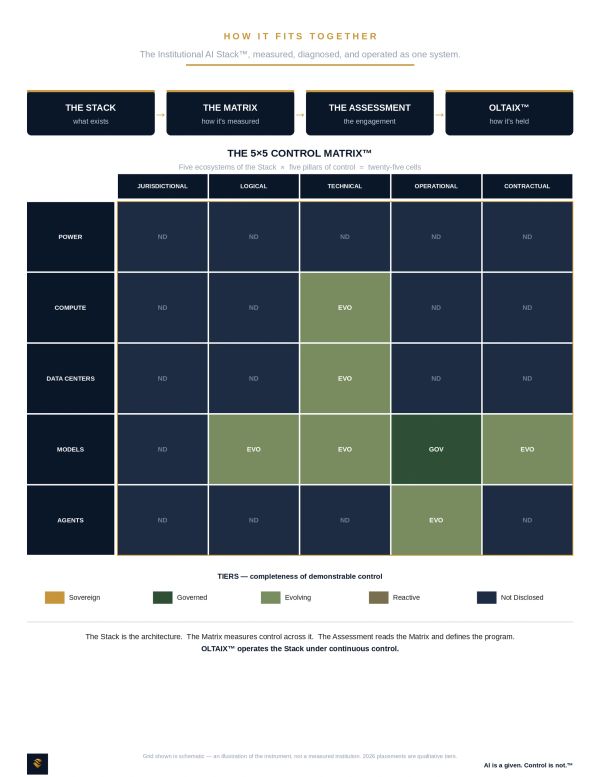
The 5×5 Control Matrix™ makes that obligation specific. It converts the broad requirement to control AI into twenty-five distinct questions — showing where control can be demonstrated, where it depends on third parties, and where evidence is missing.
The central question for investment managers is straightforward:
Can we prove that the AI acting on our investment process remains within our authority?
Five Control Commitments:
- Evaluate all twenty-five cells on evidence — not policy, provider assurance, or untested contractual language.
- Address weak control at the Models and Agents layers before expanding AI across research, portfolio construction, trading, or client communication.
- Test third-party AI arrangements against fiduciary, regulatory, data, and proprietary investment-intelligence requirements.
- Bring the Matrix to senior management and the board with clear ownership, priorities, and evidence of progress.
- Extend control across the full distribution and delegation chain — because accountability does not end where the institution’s own infrastructure ends.
For asset managers, the question is no longer simply whether AI is owned or rented. It is whether the institution can demonstrate control over the intelligence influencing capital — wherever that intelligence runs and whoever operates it.
Red Flags — When Not to Build Sovereign Infrastructure
AI is genuinely supplementary to investment process
Warning signs: AI tools are used only for administrative productivity with no involvement in investment research or portfolio decisions. Alternative: Focus governance investment proportionally.
Technology transformation underway
Warning signs: Major investment platform or data infrastructure migration in progress. Alternative: Build AI governance into the target architecture.
Insufficient investment AI expertise internally
Warning signs: No team members with quantitative model governance experience. Alternative: Build capability before infrastructure.
Investment strategy in pivot
Warning signs: Active strategy shift — moving from fundamental to quantitative, launching new asset class capability. Alternative: Establish governance around the target investment process.
Green Flags — When to Accelerate
SEC examination has asked about AI
Action: The examination focus will intensify. Every subsequent examination will test whether gaps have been remediated.
EU AI Act conformity assessment required
Action: Conformity assessment is a formal regulatory requirement. Accelerate the Models column governance programme.
A quantitative competitor has announced sovereign infrastructure
Action: Quantitative investment management is becoming a governance-differentiated market.
Client DDQ now includes AI governance questions
Action: The market is beginning to price AI governance into mandate decisions.
An AI hallucination has affected investment output
Action: This is a control failure, not a technology failure. Accelerate immediately.
Distribution partners deploying AI on your fund data
Action: If intermediaries are processing your fund data through AI systems, your control obligation extends to those relationships. Map the exposure and negotiate AI-specific data provisions.
Agentic AI proposed for investment workflows
Action: Establish the Agents column control framework before production deployment.
REQUEST The State of AI Control in Institutional Finance
AVAILABLE ON A RELATIONSHIP BASIS TO QUALIFYING INSTITUTIONS
All engagements and discussions are conducted under confidentiality protections, including NDA where applicable. Control Tiers represent Institutional AI’s analytical interpretation of public disclosure completeness and are not assessments, audits, or certifications of any institution’s actual control environment.
AI is a given. Control is not.™
101 Federal Street, Boston, MA, USA
