THE AI CONTROL GAP
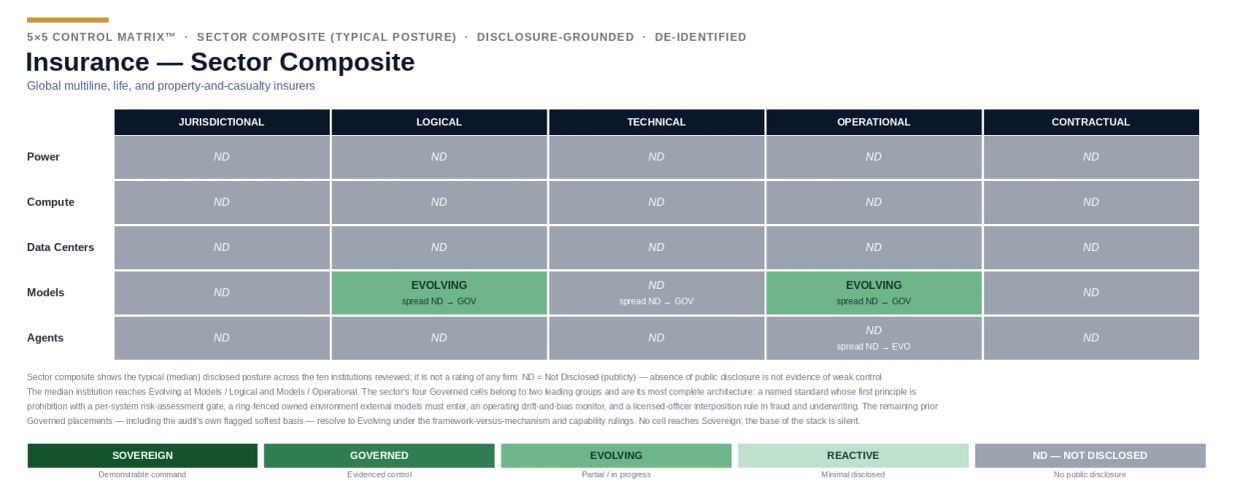
What the sector shows
Insurers sit at an evolving posture on the model layer at the typical level, on both the logical and operational dimensions, with the leading edge — concentrated among the large European groups — reaching an evidenced-control standard.
The pattern reflects a regulatory-culture effect: the strongest disclosures take the form of published, named control frameworks with mandatory, compliance-checked principles, defined accountability, and, in the strongest cases, an enforced prohibition and an operating monitoring mechanism.
The range runs from those published frameworks down to firms that disclose AI principally as a matter of regulatory monitoring or through vendor partnerships, which do not by themselves evidence the firm's own control. Where the public evidence is thinnest, evidenced control rests on platform or product framing rather than a named control mechanism.
THE INSURANCE AI CONTROL CHALLENGE

Life and Annuity Insurers
Their Mandate: Price and manage long-duration mortality, longevity, and interest rate risks — with liability streams extending decades into the future and actuarial assumptions whose accuracy determines solvency across multiple economic cycles.
Core Challenges:
- Actuarial AI governance → AI systems contributing to mortality assumption development, longevity modeling, and reserve calculations carry the same professional accountability as the appointed actuary certifying those calculations. AI-assisted actuarial work that cannot produce a complete, auditable decision trail creates regulatory and legal exposure that traditional actuarial calculations do not. The actuary signs the opinion. The AI governance framework must be able to support that signature.
- Long-duration liability matching → Life and annuity liability streams extending 30-50 years require investment strategies whose AI governance must be as durable as the obligations they fund. AI systems driving ALM decisions, duration matching, and interest rate hedging for these portfolios must be governed with the same long-horizon discipline the liabilities require.
- Policy illustration governance → AI-generated policy illustrations and retirement income projections that influence policyholder purchase decisions carry regulatory obligations under state insurance codes and SEC registration requirements for variable products. AI systems producing these outputs must satisfy the same accuracy and disclosure standards as human-produced illustrations.

Property and Casualty Insurers
Their Mandate: Price and manage short-duration property, liability, and specialty risks — with underwriting accuracy, claims efficiency, and reserving precision determining profitability across volatile loss environments.
Core Challenges:
- Underwriting AI explainability → AI-driven underwriting models that price risk, accept or decline submissions, and determine coverage terms make decisions with direct financial consequences for policyholders. State insurance regulators are developing AI explainability requirements for underwriting decisions — specifically addressing the right of policyholders to understand why coverage was denied or priced at a premium. AI underwriting systems that cannot produce explainable outputs will not satisfy these emerging standards.
- Claims AI governance → AI systems assisting in claims assessment, fraud detection, and settlement recommendations carry bad faith litigation exposure when they cannot be shown to have applied consistent, unbiased, and policy-compliant standards. Claims AI that processes claimant data under standard API terms without institution-controlled logging creates discovery exposure in litigation that manual claims handling does not.
- Catastrophe modeling and reserving → AI-assisted catastrophe modeling, loss development projections, and reserve adequacy assessments are regulatory filings with financial consequence. Reserve calculations that depend on AI systems whose governance cannot be demonstrated create appointed actuary certification risk and regulatory examination exposure simultaneously.
Health Insurers and Managed Care Organizations
Their Mandate: Manage health risk, administer benefits, and ensure care access for policyholders under HIPAA, ACA, state insurance regulations, and — for government programs — CMS requirements that create the most complex regulatory environment in the insurance sector.
Core Challenges:
- Clinical AI governance → AI systems contributing to prior authorization decisions, utilization management, and care management recommendations make decisions that directly affect patient health outcomes. State and federal regulators are moving aggressively toward AI governance requirements for clinical decision support — specifically addressing algorithmic bias, explainability, and audit trail requirements. Health insurers deploying clinical AI without documented governance frameworks are accumulating regulatory exposure that is materializing faster than any other insurance AI governance risk.
- Protected health information sovereignty → HIPAA's technical safeguard requirements apply to AI systems processing protected health information. PHI submitted to external AI models under standard API terms is processed on provider infrastructure without the technical controls HIPAA requires. The covered entity cannot discharge its PHI protection obligations by pointing to a provider's attestation — it must demonstrate technical control.
- Medicare Advantage and government program compliance → AI systems used in Medicare Advantage plan administration, prior authorization, and utilization management are subject to CMS oversight that is specifically examining AI use following high-profile enforcement actions. The MA plan that cannot demonstrate that AI governance meets CMS standards is operating under regulatory risk that is already being enforced.
Reinsurance Companies
Their Mandate: Assume portions of primary insurers' risk portfolios — pricing, structuring, and managing exposures across global markets, catastrophe events, and specialty lines where actuarial precision and data sovereignty are simultaneously critical.
Core Challenges:
- Cedant data sovereignty → Reinsurers process cedant data — policy details, claims histories, portfolio compositions — that is confidential commercial intelligence whose governance obligations extend beyond the reinsurer's own regulatory framework. AI systems processing cedant data under standard terms create data sovereignty gaps that affect the reinsurer's relationships with cedants who expect their data to be protected technically, not just contractually.
- Catastrophe model governance → Proprietary catastrophe models represent decades of accumulated analytical investment and competitive advantage. These models — and the cedant exposure data they process — submitted to external AI for enhancement or analysis are processed on provider infrastructure without the technical protection that proprietary model governance requires.
- Treaty and facultative pricing intelligence → AI-assisted treaty pricing, facultative underwriting, and exposure aggregation processes competitive intelligence about reinsurance market positioning that, if disclosed, would compromise negotiating position with cedants and retrocessionaires simultaneously.
REQUEST The State of AI Control in Institutional Finance
AVAILABLE ON A RELATIONSHIP BASIS TO QUALIFYING INSTITUTIONS
All engagements and discussions are conducted under confidentiality protections, including NDA where applicable. Control Tiers represent Institutional AI’s analytical interpretation of public disclosure completeness and are not assessments, audits, or certifications of any institution’s actual control environment.
AI is a given. Control is not.™
101 Federal Street, Boston, MA, USA
