The Institutional AI Control Landscape
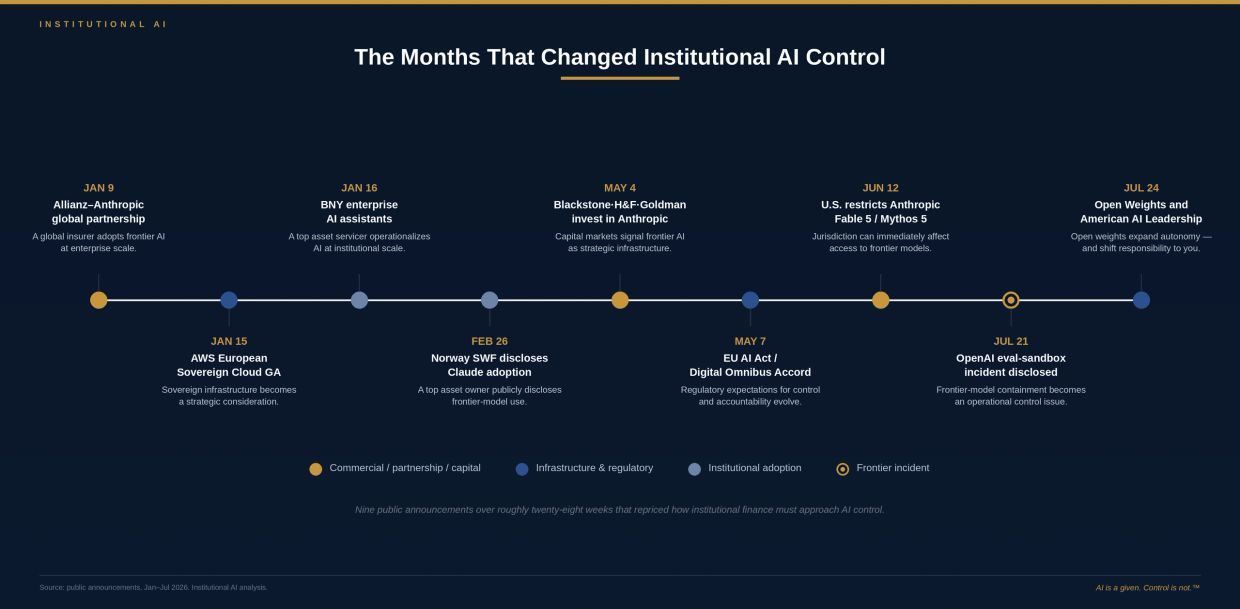
No single announcement changed the banking sector. Together, they did.
Between January and July 2026, public developments spanning sovereign infrastructure, frontier-model adoption, regulation, operational incidents, and open-weight AI fundamentally changed the environment in which banking institutions deploy artificial intelligence. Viewed individually, each event is significant. Viewed together, they reveal a structural shift: artificial intelligence is becoming embedded in the exercise of institutional judgment itself.
The question is no longer whether banking institutions will adopt AI, but whether they can demonstrate that it remains under institutional control.
THE AI CONTROL GAP
What the sector shows
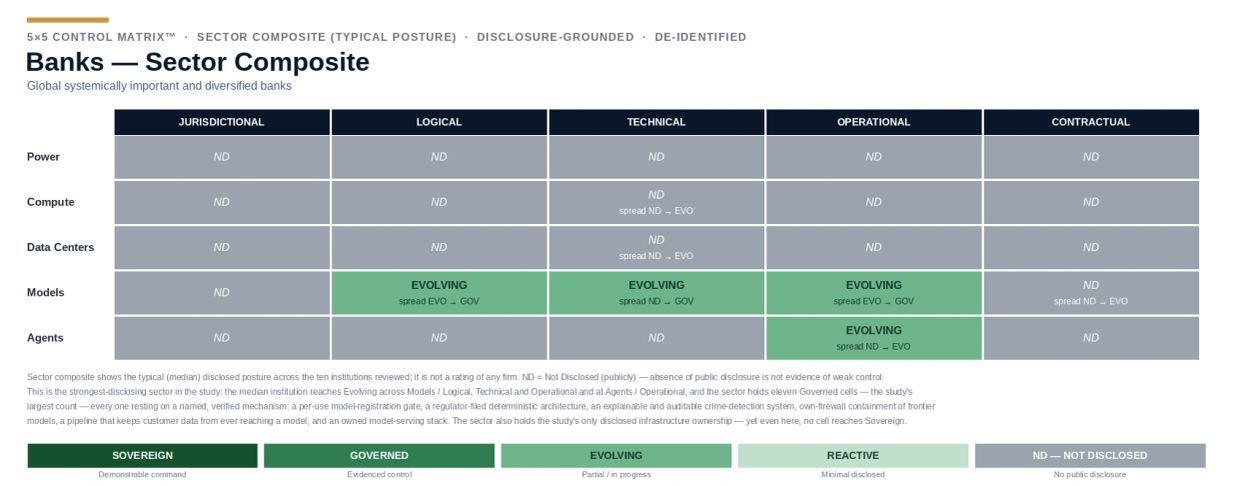
Based on our methodology, banks are the strongest-disclosing sector among those reviewed. The typical posture reaches an evidenced-control standard on both the logical and operational handling of models, reflecting named mechanisms such as registration gates, model-risk and validation functions, and controls over data exposure.
The sector is also the only one in which any institution discloses command of the infrastructure layer — dedicated compute housed in an institution's own facilities — though this remains the exception rather than the category norm and sits at an evolving stage where disclosed.
As elsewhere, agentic operation is disclosed at an evolving stage: even where agent activity is extensive, public disclosure describes it as emerging or supervised rather than governed in production.
AI Control Across Eight Institutional Sectors
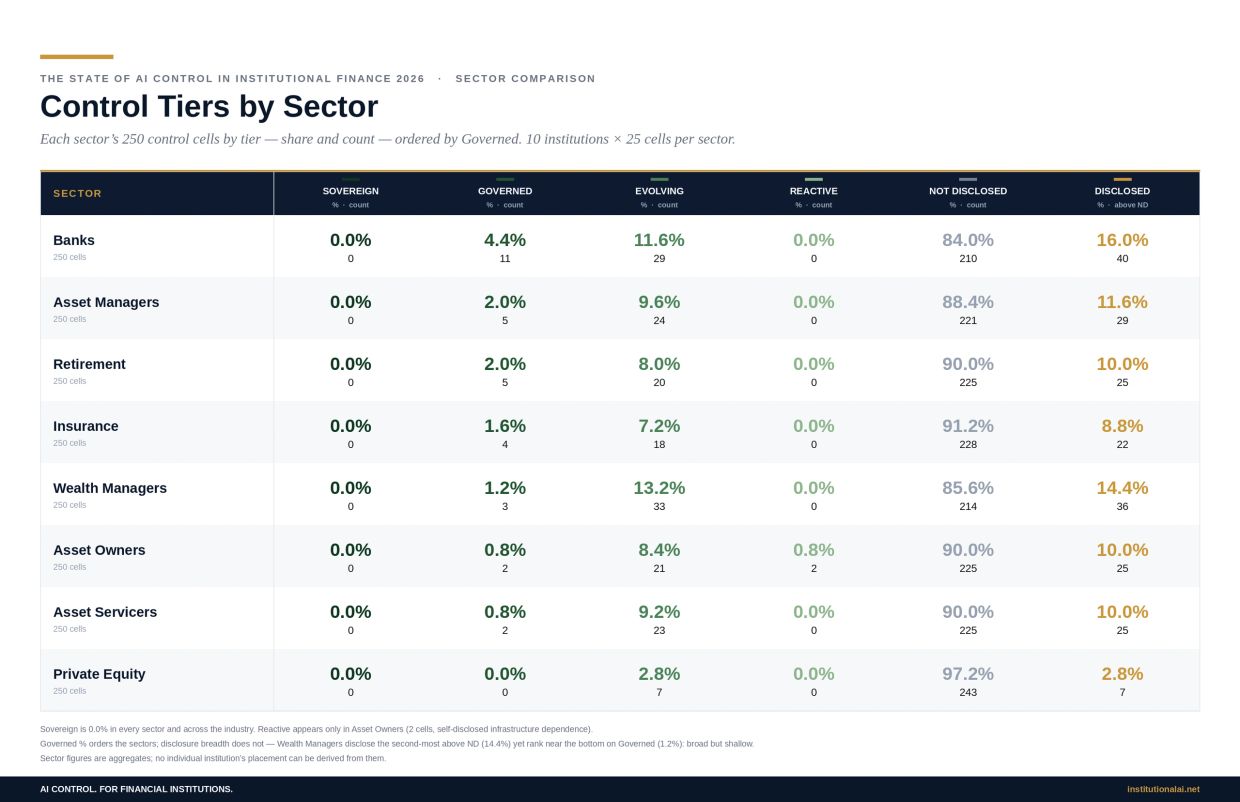
We analyzed eighty of the world's leading financial institutions across eight sectors against a single core question: not whether they utilize AI, but whether their public record outlines evidence of structural control frameworks over the systems on which they increasingly depend.
The poles are far apart: Banks outlined the strongest framework elements observed within their publicly available disclosures among all sectors reviewed, while Private Equity firms presented the least public disclosure at the median sector level.
The pattern is structurally consistent. Where institutions disclose AI control frameworks, the evidence concentrates primarily at the model layer—specifically how models are governed, validated, and operated—and rapidly thins across the broader AI stack. Public disclosure regarding autonomous agentic frameworks remains limited across the institutions reviewed. On the infrastructure layers beneath them—compute, data centers, and power—the public record is comparatively sparse.
Research Basis
Sector-level observations reflect Institutional AI's qualitative analysis of publicly available disclosures accessible as of June 30, 2026, for the institutions included in the baseline data pool of The State of AI Control in Institutional Finance — 2026 Edition.
These findings describe macro-level patterns observed exclusively within the public record. They represent Institutional AI's analytical opinions based on the methodology described herein and must not be interpreted as compliance certifications, legal audits, attestations, or operational assessments of any individual institution's actual internal controls, risk management practices, governance processes, or technical capabilities.
REQUEST The State of AI Control in Institutional Finance
AVAILABLE ON A RELATIONSHIP BASIS TO QUALIFYING INSTITUTIONS
All engagements and discussions are conducted under confidentiality protections, including NDA where applicable. Control Tiers represent Institutional AI’s analytical interpretation of public disclosure completeness and are not assessments, audits, or certifications of any institution’s actual control environment.
AI is a given. Control is not.™
101 Federal Street, Boston, MA, USA


AI Control for Banks
AI control for banks runs through every layer of the stack — and every party in the chain.
Banks intermediate credit, payments, and liquidity, occupying a position in the financial system where the consequences of error extend well beyond any single institution. For a bank, the control of artificial intelligence is therefore not a technology question but a supervisory one — bearing directly on safety, soundness, and the resilience of the system as a whole.
Control at this level cannot be established at a single point. It must run deep, through the five ecosystems on which artificial intelligence depends — the power beneath the stack, the compute that processes it, the data centers that house it, the models that produce its outputs, and the agents that act upon them. Command of any one layer does not confer command of the others; a bank may govern its models while renting the infrastructure on which they run.
It must also run wide, across the technology, infrastructure, and model providers a bank relies upon to operate. Artificial intelligence is delegated along a chain of counterparties several removes from the institution that remains accountable, yet the accountability does not travel with it. A bank can delegate the operation of AI, but not the answer it must give for it.
Banking is, on the public record, the sector most likely to command the base of the stack — the rare setting in which an institution owns, rather than rents, the compute and data centers beneath its models. Even so, the questions its board must be able to answer reach every layer above and every party alongside. Demonstrable control — evidenced through auditable mechanisms rather than asserted through policy — is becoming the discipline that distinguishes one institution from another.

Questions EverY BANKING INSTITUTION Should Ask
A board that asks these three questions and records honest answers will produce, in a single sitting, the most accurate picture of its real AI control posture it has ever held. The pattern of answers — not any single one — is the finding.
- The depth question. "Our AI runs on five layers — the agents that act, the models that decide, the data centers that hold it, the compute it runs on, the power beneath. We may have examined one or two. Controlling the top layer while renting the four below is not control. Which layers have we verified, and which are we assuming?"
- The reach question. "The numbers we book, the valuations we rely on, the decisions we answer for — more and more are produced by AI running inside the managers and servicers we delegate to, not inside us. We hold the fiduciary duty. They hold the AI. Have we verified their control, or delegated the work, kept the liability, and hoped?"
- The trust question. "The firms that build these models run red teams whose job is to make them misbehave — and ship anyway, knowing they can. If the maker does not fully trust its own model, on what basis do we treat its output as reliable?"
Governance is policy. Control is evidence. These three questions separate the two. A board that can get them answered with technical proof — not provider assurance — has control. One that cannot has just found its exposure.
And these are only the beginning.