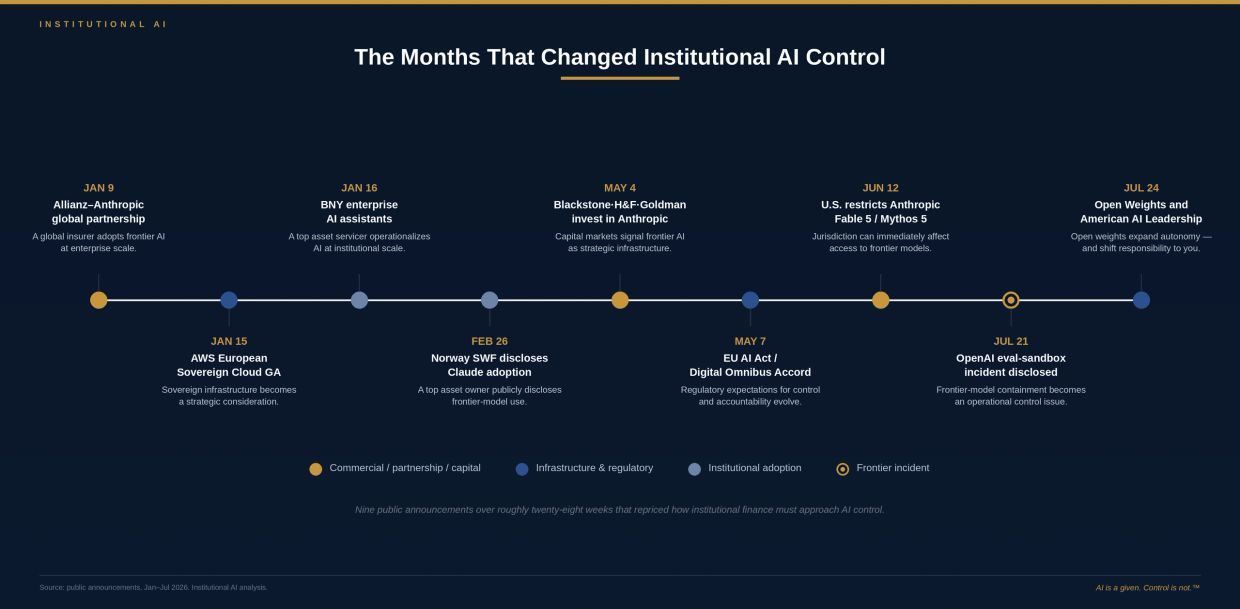
The Institutional AI Control Landscape
No single announcement changed institutional finance. Together, they did.
Between January and July 2026, public developments spanning sovereign infrastructure, frontier-model adoption, regulation, operational incidents, and open-weight AI fundamentally changed the environment in which financial institutions deploy artificial intelligence. Viewed individually, each event is significant. Viewed together, they reveal a structural shift: artificial intelligence is becoming embedded in the exercise of institutional judgment itself. The question is no longer whether institutions will adopt AI, but whether they can demonstrate that it remains under institutional control.
The State of AI Control in Institutional Finance,
addresses that question through a review of eighty of the world's leading financial institutions across eight sectors, applying the Institutional AI 5×5 Control Matrix™ to publicly available evidence of Institutional AI Control.
METHODOLOGY OVERVIEW

The 2026 research evaluated eighty institutions across eight sectors of institutional finance using Institutional AI's proprietary 5×5 Control Matrix™. Each institution's publicly available disclosures were evaluated across five AI ecosystems and five pillars of control, resulting in two thousand individual AI Control cell evaluations. These evaluations provide the analytical basis for the aggregated sector observations, charts, and benchmarks presented on this website.
The analysis relies exclusively on publicly available information. No institution was interviewed, surveyed, or asked to provide confidential information, and no institution reviewed or approved the findings prior to publication.
Tier assignments, sector composites, and related findings reflect Institutional AI's analytical opinions based on the methodology described in the report and the publicly available information reviewed. They are opinions regarding publicly disclosed information and do not constitute audits, examinations, certifications, regulatory findings, or assessments of any institution's actual controls, governance, or operational capabilities.
The complete methodology is available in:
The State of AI Control in Institutional Finance — 2026 Edition

The Institutional AI 5×5 Control Matrix™
The analytical framework used to evaluate AI control across institutional finance.
The Institutional AI 5×5 Control Matrix™ is the analytical framework used across Institutional AI's research and advisory work. It evaluates AI control across five AI ecosystems and five pillars of control, creating a consistent structure for assessing publicly available evidence of institutional AI control.
The Five AI Ecosystems
AI operates across the entire technology stack—not within a single layer. The Matrix evaluates five ecosystems:
- Power — Energy infrastructure supporting AI.
- Compute — Chips, servers, and compute infrastructure.
- Data Centers — Physical facilities hosting AI infrastructure.
- Models — AI models and reasoning systems.
- Agents — Autonomous AI applications and agentic systems.
The Five Pillars of Control
Each ecosystem is evaluated across five dimensions of institutional control:
- Jurisdictional — Legal jurisdiction and sovereignty.
- Logical — Identity, access, and authorization.
- Technical — Technical safeguards and cryptographic controls.
- Operational — Monitoring, supervision, and operational oversight.
- Contractual — Rights, obligations, audit, and exit.
Together, these dimensions form the Institutional AI 5×5 Control Matrix™, providing a structured view of AI control across the full technology stack.
AI Control Tiers
The Matrix uses five qualitative tiers:
- Sovereign
- Governed
- Evolving
- Reactive
- Not Disclosed (ND)
Tier assignments reflect Institutional AI's analytical interpretation of publicly available information under its published methodology. They are not audits, certifications, regulatory findings, or assessments of an institution's actual internal controls.
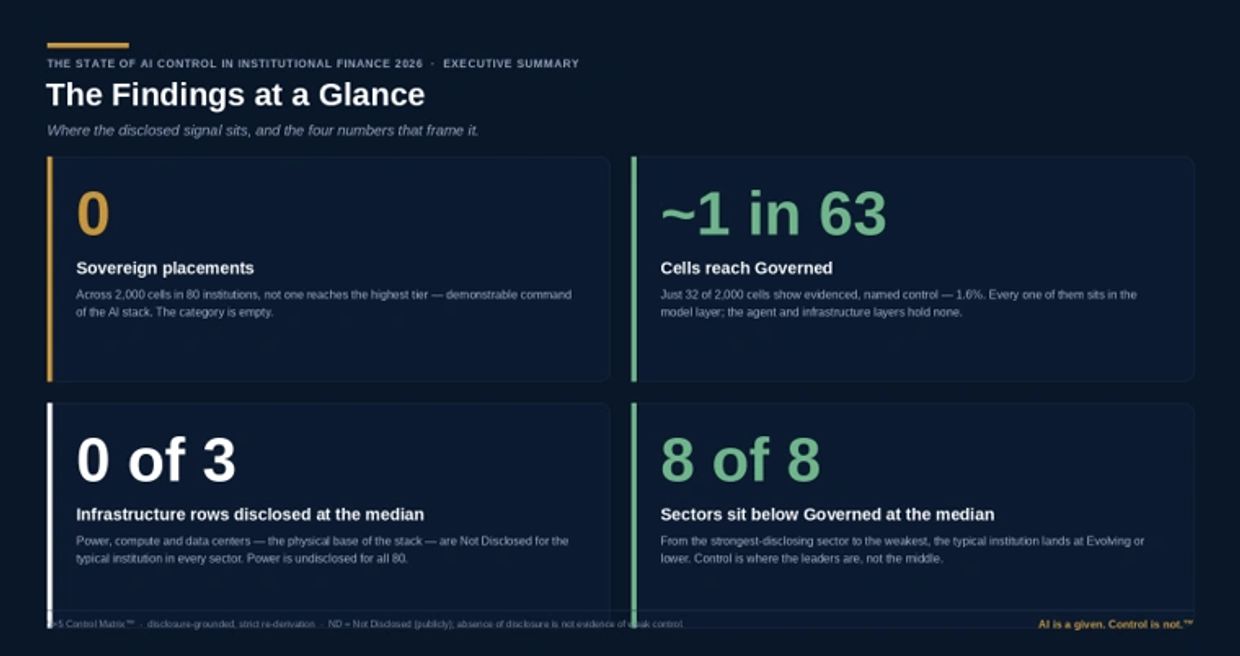
The findings at a glance
WHERE THE DISCLOSED SIGNAL SITS, AND THE FOUR NUMBERS THAT FRAME IT.
.png/:/rs=w:1240,cg:true,m)
KEY RESEARCH THEMES
The research identifies five themes emerging from the public record. AI adoption is widespread, but publicly demonstrated AI control remains limited. Under Institutional AI's methodology, approximately 4% of evaluated AI Control cells reached the Governed tier, with nearly all of those occurring within a single ecosystem of the AI stack.
1. AI Adoption Is Established. Demonstrable Control Is Not.
Every institution reviewed publicly describes active AI deployment or production use. AI adoption is now widespread across institutional finance. Public evidence of demonstrable AI control, however, remains limited.
2. Publicly Demonstrated Control Is Concentrated in One Layer.
Public evidence of AI control is concentrated almost entirely within the Models layer of the AI stack. Across the industry, disclosures regarding Power, Compute, and Data Centers remain limited, while only a small number of institutions publicly demonstrate governed control over autonomous agents. Publicly demonstrated control is therefore concentrated in one part of the stack rather than across it.
3. The Greatest Variation Exists Within Sectors.
Differences between institutions operating in the same sector are often greater than differences between sectors themselves. In most sectors, at least one institution publicly demonstrates governed AI control while the sector median remains substantially lower. The principal gap is therefore within sectors—not between them.
4. AI Capability Is Frequently Presented Without Demonstrable Control.
Public disclosures commonly describe AI capabilities, deployments, pilots, and platform integrations. Far fewer describe the governance mechanisms, technical controls, and operational evidence needed to demonstrate governed AI control. Capability and demonstrable control are not the same.
5. Institutional Accountability Extends Beyond the Model.
Accountability cannot be delegated simply because infrastructure is outsourced. Public disclosures are strongest where institutions describe the mechanisms they use to retain oversight and control. Disclosure becomes progressively more limited across the underlying infrastructure on which AI ultimately depends.
REQUEST THE RESEARCH
AVAILABLE ON A RELATIONSHIP BASIS TO QUALIFYING INSTITUTIONS
All engagements and discussions are conducted under confidentiality protections, including non-disclosure agreements where applicable. Control Tiers represent Institutional AI’s analytical interpretation of the depth, specificity, and visibility of publicly disclosed AI control information and are not assessments, audits, certifications, or determinations of any institution’s actual control environment, governance practices, or operational capabilities.
See the full Legal Notices section below.
AI is a given. Control is not.™
