THE PENSION FUND AI CONTROL CHALLENGE
Public Sector Pension Funds
Their Mandate: Secure defined benefit retirement income for public sector employees — teachers, firefighters, police officers, government workers — under trustee governance frameworks that demand demonstrable prudence and full accountability to beneficiaries, governments, and taxpayers.
Core Challenges:
- Trustee fiduciary accountability → Pension fund trustees carry personal fiduciary liability for investment decisions. As AI contributes more to those decisions — through investment research synthesis, portfolio construction inputs, and risk analysis — the trustee board must be able to demonstrate that AI governance meets the prudent expert standard. Most trustee boards cannot. The gap between AI deployment and trustee-level accountability is the governance gap.
- Political and public accountability → Public pension funds face scrutiny from governments, legislatures, unions, and beneficiaries that private funds do not. AI governance failures — model drift producing incorrect liability projections, AI-assisted portfolio decisions that cannot be explained, data breaches affecting beneficiary records — create public accountability consequences that extend far beyond financial penalties.
- Actuarial AI governance → AI systems contributing to actuarial assumptions, liability projections, and funding ratio calculations carry the same professional liability as human actuaries. AI-assisted actuarial work that cannot produce a complete, auditable decision trail creates governance risk that most public pension fund boards have not yet mapped.

Private Sector Defined Benefit Plans
Their Mandate: Manage pension obligations to private sector employees under ERISA's fiduciary standard — the highest in US law — with the precision that matching long-term liabilities to investment returns requires.
Core Challenges:
- ERISA fiduciary extension to AI → ERISA's prudent expert standard applies to every system contributing to investment decisions — including AI. AI-assisted investment research, portfolio construction, and risk management that cannot produce decision provenance records sufficient for DOL examination creates fiduciary exposure that accumulates with every AI deployment.
- DOL examination readiness → ERISA Section 504 grants the DOL authority to demand any records related to plan administration and investment management. AI system logs are records. Interaction logs held only in provider systems may not be producible on DOL demand — a direct ERISA compliance gap.
- Investment consultant AI governance cascade → Most private defined benefit plans delegate investment management to external managers and consultants. When those managers and consultants deploy AI in investment processes, the plan's ERISA fiduciary obligations extend to the AI governance of those service providers. Most plans have not yet mapped what that means.
Multi-Employer and Union Pension Funds
Their Mandate: Manage pension benefits for workers across multiple contributing employers in the same industry — construction, transportation, healthcare, entertainment — under Taft-Hartley governance structures with joint labor-management trustee boards.
Core Challenges:
- Trustee board AI literacy → Joint trustee boards — often composed of union representatives and employer representatives without investment backgrounds — face the same fiduciary obligations to AI governance as boards with sophisticated investment professionals. The gap between trustee fiduciary obligation and trustee AI understanding is the most acute governance gap in the multi-employer pension sector.
- Contribution volatility and AI planning → Multi-employer funds face contribution streams that vary with employment levels in cyclical industries. AI systems forecasting contribution income, modeling liquidity, and projecting funding ratios must be governed with the same rigor as the actuarial assumptions they inform. Most are not.
- Withdrawal liability calculation AI → AI-assisted calculation of employer withdrawal liability — the obligation an employer incurs when leaving a multi-employer plan — has direct financial consequences for withdrawing employers. These calculations must be defensible in arbitration and litigation. AI systems producing withdrawal liability calculations that cannot be fully audited create legal exposure that traditional actuarial calculations do not.
Sovereign and National Pension Funds
Their Mandate: Manage national pension reserves, sovereign pension obligations, or state pension systems at scale — with political independence requirements, national economic accountability, and geopolitical exposure that private pension funds do not face.
Core Challenges:
- Geopolitical AI exposure → Sovereign pension funds processing investment strategy, asset allocation, and portfolio positioning data on foreign AI infrastructure face the possibility that government demands on model providers could result in disclosure without fund knowledge. The national interest dimensions of sovereign pension intelligence make this exposure qualitatively different from private sector AI governance gaps.
- Independence and governance integrity → Sovereign pension funds operate under political independence mandates designed to protect beneficiaries from short-term political interference. AI systems that are opaque, ungoverned, or dependent on foreign providers create governance vulnerabilities that threaten the independence mandate as directly as political interference.
- Scale and systemic risk → Sovereign pension funds managing hundreds of billions — or trillions — in assets create systemic risk through AI failures that private funds do not. Model errors, AI-driven momentum trading at scale, or AI governance failures affecting liability projections at national scale have macroeconomic consequences. The governance standard must match the systemic significance.
PUTTING PENSION FUNDS IN CONTROL OF AI

Pension funds manage the retirement security of millions of beneficiaries
Pension funds manage the retirement security of millions of beneficiaries who have no alternative and no recourse. The fiduciary obligation that standard creates extends to every system that touches investment decisions, risk analysis, and benefit administration — including AI.
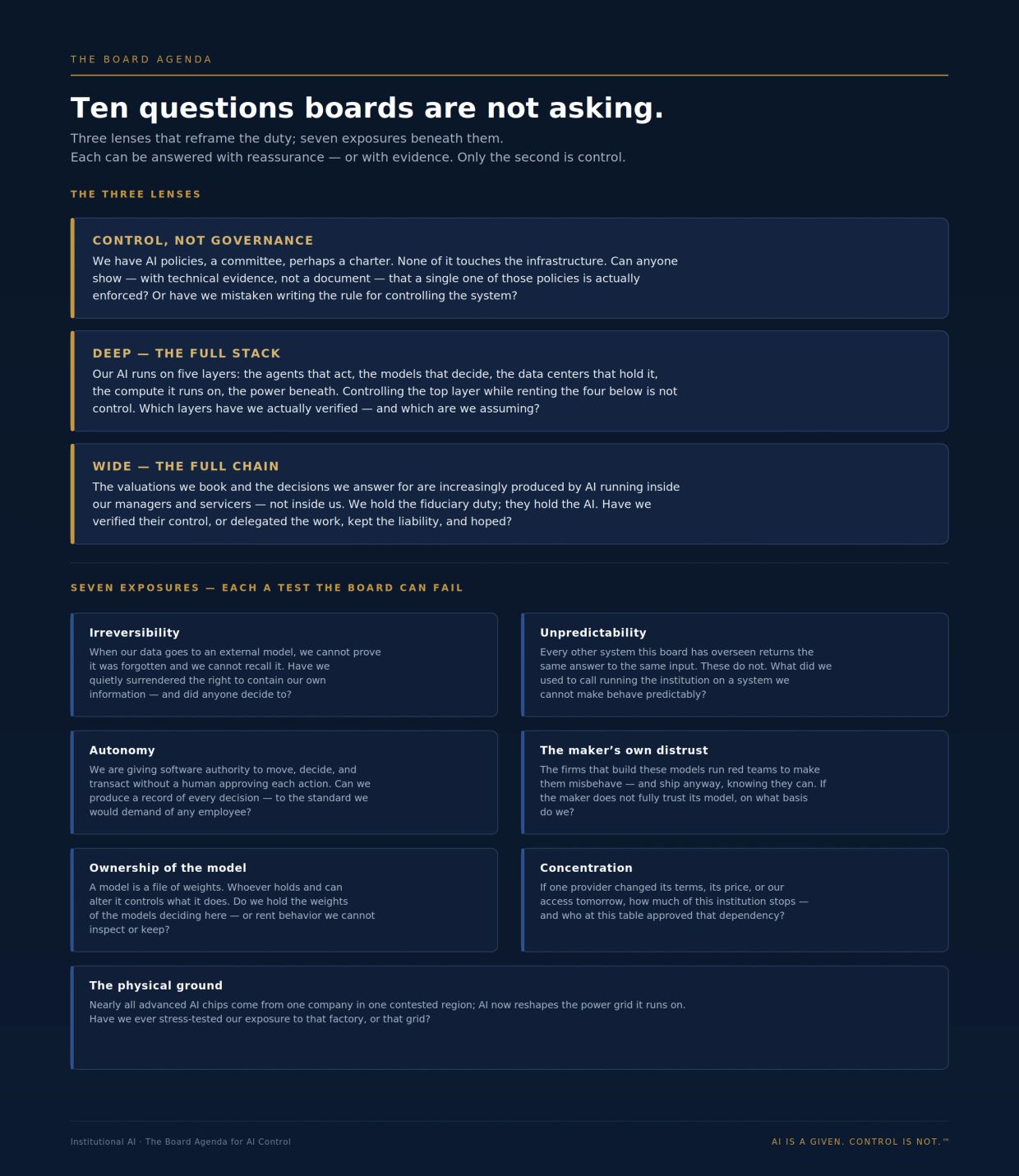
When AI drives asset allocation decisions, informs liability projections, selects and monitors managers, and processes benefit payments — who demonstrates that the AI meets the prudent expert standard? Who explains the investment decision to the trustee board? Who bears the fiduciary liability when AI contributes to a funding ratio deterioration that cannot be explained?
The answer cannot be: a provider whose infrastructure processes pension fund intelligence under standard terms that were not written for ERISA or pension fiduciary obligations.
Pension funds require SOVEREIGN AI™ — intelligence they own, govern, and trust. Built on The Institutional AI Stack™ and orchestrated through OLTAIX™, where every investment decision is traceable, every risk determination is explainable, and every action affecting beneficiary retirement security is auditable to the trustee board and to every regulator with oversight authority.
Because the beneficiaries depending on the fund's fiduciary discipline have no other option.
AI IS A GIVEN. CONTROL IS NOT.
"SMALL YARD AND HIGH FENCE"
In geopolitics, small yard and high fence means protecting the few technologies that truly define strategic advantage. For asset owners, that technology is AI.
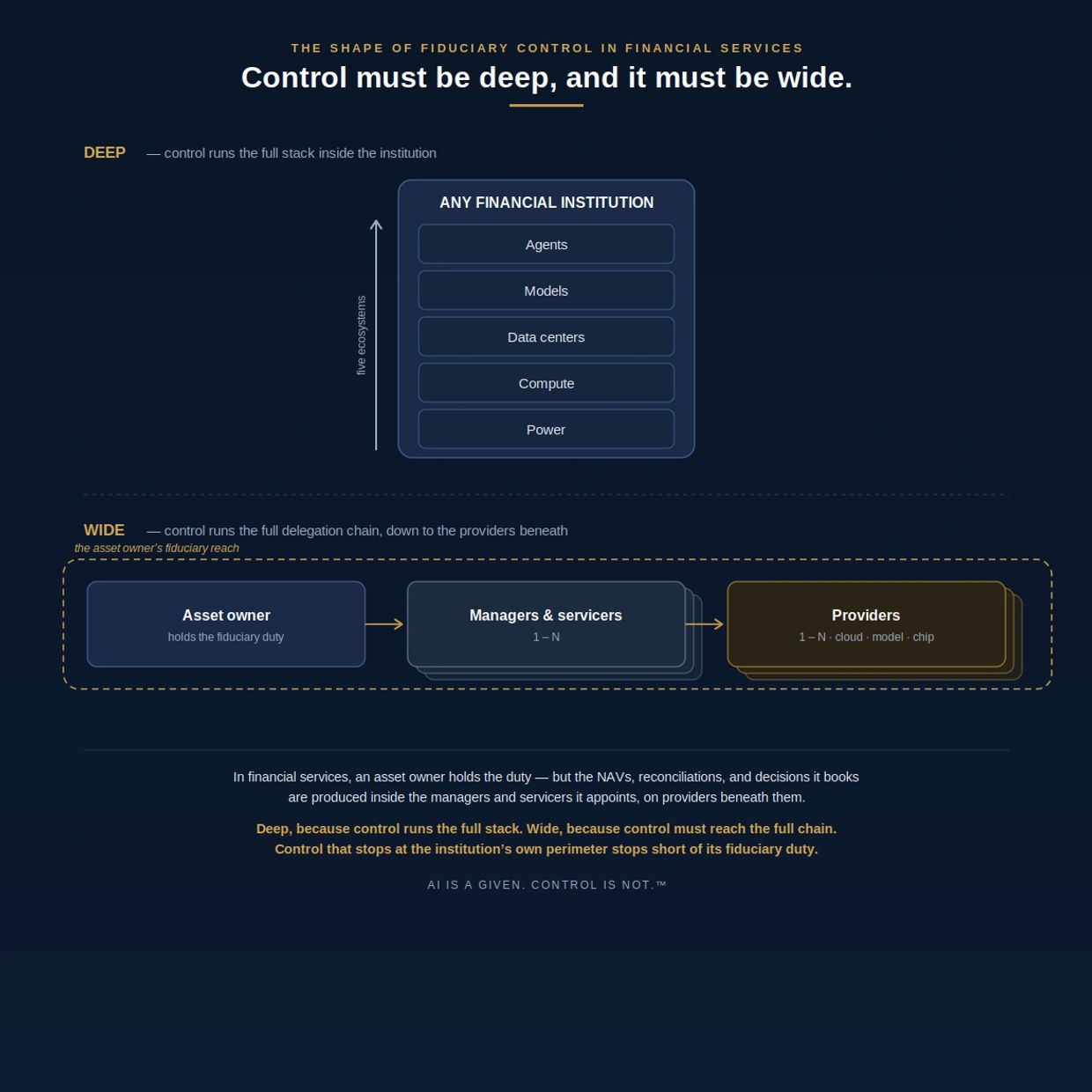
The challenge is not access to AI. Every asset owner has access. The challenge is control. Who owns the data. Who governs the models. Who ensures fiduciary transparency, explainability, and trust — not through provider promises, but through technical architecture that enforces it.
An AI Stack for Asset Owners is more than infrastructure. It is a sovereign intelligence environment that unites purpose-built compute for fiduciary workloads, governed data across public and private assets, context-aware models operating within institutional policy, and governance embedded in every layer.
At Institutional AI, we call this the Institutional AI Stack™ — the first end-to-end architecture for fiduciary-grade AI governance, built for the stewards of the world's capital.
ILLUSTRATIVE USE CASES- PENSION FUNDS

BENEFICIARY SERVICES & ADMINISTRATION
From manual benefit processing → governed autonomous administration
Use Cases
- AI-driven benefit calculation verification and payment processing
- Beneficiary record maintenance and data quality monitoring
- Member communication and retirement readiness guidance
- Death benefit and survivor claim processing automation
Value Creation
- Reduced administrative cost and error rates
- Faster benefit processing for retiring members
- Improved member experience through proactive, accurate communication
Governance Reality Check
AI agents autonomously processing benefit calculations, payment authorizations, and member communications are performing plan administration functions that carry full fiduciary liability. Every automated action affecting a beneficiary's retirement income must be completely traceable from institution-controlled audit records — producible for regulatory examination within 24 hours. Most pension fund AI deployments in benefit administration cannot meet that standard.
Tie to Stack
- Agentic Applications → benefit administration agents with complete action logging and human oversight
- OLTAIX™ → enforces documentation requirements, logs every agent action in institution-controlled systems
MANAGER SELECTION & MONITORING
From periodic manager reviews → continuous performance intelligence
Use Cases
- AI-driven manager due diligence and selection support
- Continuous performance attribution and mandate compliance monitoring
- Style drift detection and early warning across the manager universe
- Fee analysis and benchmarking across mandates
Value Creation
- More rigorous, consistent manager evaluation across asset classes
- Early identification of mandate drift before performance impact
- Reduced cost of ongoing manager monitoring
Governance Reality Check
AI systems informing manager selection decisions carry the same fiduciary standard as human investment staff making those decisions. Manager selection AI that cannot produce a traceable decision chain from analysis to recommendation creates trustee accountability gaps that manual processes do not.
Tie to Stack
- Models + Data → governed manager intelligence with complete analytical provenance
- OLTAIX™ → mandate compliance monitoring with real-time alerting
OPERATIONAL GOVERNANCE & REPORTING
From manual trustee reporting → governed real-time transparency
Use Cases
- AI-generated trustee board reports with plain-language investment attribution
- Actuarial assumption monitoring and sensitivity analysis
- Beneficiary data governance and record accuracy verification
- Regulatory filing preparation and accuracy verification
Value Creation
- Trustee board confidence through timely, explainable investment reporting
- Reduced cost of regulatory reporting and filing preparation
- Demonstrable governance posture for regulatory examination
Industry Signal
Pension regulators are beginning to include AI governance questions in routine fund examinations. The fund that can demonstrate a documented, scored AI governance framework — with evidence that AI systems contributing to investment decisions are governed to the prudent expert standard — will be in a materially different examination position than the fund building it in response to regulatory findings.
Tie to Stack
- Agentic Applications → governed reporting and operational workflows
- OLTAIX™ → data integrity and consistency across all trustee and regulatory outputs