THE SOVEREIGN WEALTH FUND AI CONTROL CHALLENGE

Commodity and Natural Resource Funds
Their Mandate: Convert finite natural resource wealth — oil, gas, minerals — into diversified, perpetual investment portfolios that serve current and future generations, insulating national economies from commodity price volatility.
Core Challenges:
- Intergenerational intelligence sovereignty → Commodity funds manage wealth that belongs not just to current citizens but to citizens not yet born. The AI processing investment strategies for those future generations should be governed to a standard that reflects that intergenerational obligation — not standard API terms written for commercial enterprises.
- Commodity market intelligence exposure → AI-assisted commodity market analysis, futures positioning, and correlation modeling processes intelligence about sovereign fund market views that, if disclosed, could move commodity markets and benefit adversarial actors at national economic cost. The technical governance of that intelligence is a national economic security matter, not just an investment governance question.
- Diversification strategy confidentiality → The strategic process of diversifying out of commodity dependence — selecting asset classes, geographies, and manager relationships — is itself sensitive intelligence. AI processing that strategy under standard terms is processing national economic strategy on foreign infrastructure.
Stabilization Funds
Their Mandate: Maintain fiscal buffers that protect national economies from commodity price shocks, economic downturns, and external financial crises — with liquidity requirements and risk constraints that reflect the macroeconomic stabilization function.
Core Challenges:
- Macroeconomic intelligence sensitivity → Stabilization fund investment decisions are inseparable from macroeconomic policy. AI processing stabilization fund positioning and liquidity management strategies is processing intelligence that, in the hands of adversarial actors or market participants, could compromise monetary policy effectiveness and national economic resilience.
- Intervention timing confidentiality → Stabilization funds that intervene in currency markets, support domestic financial institutions, or provide emergency fiscal liquidity do so with timing and scale that is highly sensitive. AI systems that support those intervention decisions must be governed with the operational security standards appropriate to their macroeconomic consequence.
- Political independence protection → Stabilization funds depend on political independence to function effectively. AI systems that create opacity in investment decision-making — because they are ungoverned, unexplainable, or dependent on foreign providers — create accountability gaps that political actors can exploit to challenge the fund's independence mandate.
Development and Strategic Investment Funds
Their Mandate: Deploy capital in pursuit of national development objectives — infrastructure, technology, industrial capacity — alongside financial return, with investment decisions that reflect both economic and strategic national priorities.
Core Challenges:
- Strategic investment intelligence → Development funds investing in technology, infrastructure, and industrial capacity in strategic sectors are making decisions whose intelligence value extends far beyond financial return. AI processing deal analysis, sector assessment, and portfolio company intelligence for these investments is processing national strategic intelligence on infrastructure that may be subject to foreign government legal demands.
- Co-investment partner confidentiality → Development funds frequently co-invest with private equity firms, sovereign funds of allied nations, and strategic corporate partners. The terms, scale, and rationale of those co-investments — often processed by AI in due diligence and portfolio monitoring — represent confidential commercial intelligence whose disclosure would damage co-investment relationships and national strategic interests simultaneously.
- ESG and strategic mandate tension → Development funds increasingly face ESG reporting obligations alongside strategic investment mandates that may create tension. AI systems generating ESG assessments, impact measurements, and sustainability reporting for development fund portfolios must be governed to the same standard as the investment decisions they accompany — with complete audit trails and explainable outputs for government and public accountability.
Sovereign Pension Reserve Funds
Their Mandate: Pre-fund future pension obligations or supplement national social security systems — managing long-duration liabilities with investment returns that protect the retirement security of entire national populations.
Core Challenges:
- National pension intelligence → Sovereign pension reserve funds manage intelligence about national demographic trajectories, actuarial assumptions, and liability projections that is simultaneously financial, economic, and politically sensitive. AI processing this intelligence under standard terms creates disclosure risks with national policy consequences.
- Scale and systemic significance → Sovereign pension reserve funds managing hundreds of billions in assets create systemic risk through AI failures that smaller pension funds do not. Model errors affecting liability projections or investment allocation at national scale have macroeconomic consequences requiring governance standards that match the systemic significance.
- Government accountability obligations → Sovereign pension reserve funds answer to governments, parliaments, and ultimately citizens in ways that create formal accountability obligations around investment decision-making. AI systems contributing to those decisions must produce audit trails and explainable outputs sufficient to satisfy parliamentary scrutiny — a standard that commercial API terms do not address.
PUTTING SOVEREIGN WEALTH FUNDS IN CONTROL OF AI
.png/:/rs=w:1240,cg:true,m)
Sovereign wealth funds (swfs) manage national wealth accumulated over generations, on behalf of citizens whose economic futures depend entirely on the fund's governance discipline. The investment intelligence they generate — positioning, strategy, direct investment rationale, macro views — is among the most strategically sensitive financial information in the world.
When AI drives asset allocation, processes direct investment due diligence, monitors the external manager universe, and generates the reports that governments and parliaments rely on — who protects the national intelligence? Who demonstrates to the government that AI governance meets the mandate's standard? Who bears the accountability when AI contributes to an investment outcome that cannot be explained to a parliamentary committee?
The answer cannot be: a foreign provider whose infrastructure processes sovereign investment intelligence under standard commercial terms that do not recognize its national strategic significance.
Sovereign wealth funds require AI CONTROL — intelligence they own, govern, and trust. Built on The Institutional AI Stack™ and orchestrated through OLTAIX™, where every investment decision is traceable, every risk determination is explainable, and every action affecting national wealth is auditable to the board, the government, and the citizens the fund serves.
Because the national wealth managed by the fund belongs to generations not yet born. The governance standard must reflect that obligation.
THE STATE OF AI CONTROL IN INSTITUTIONAL FINANCE
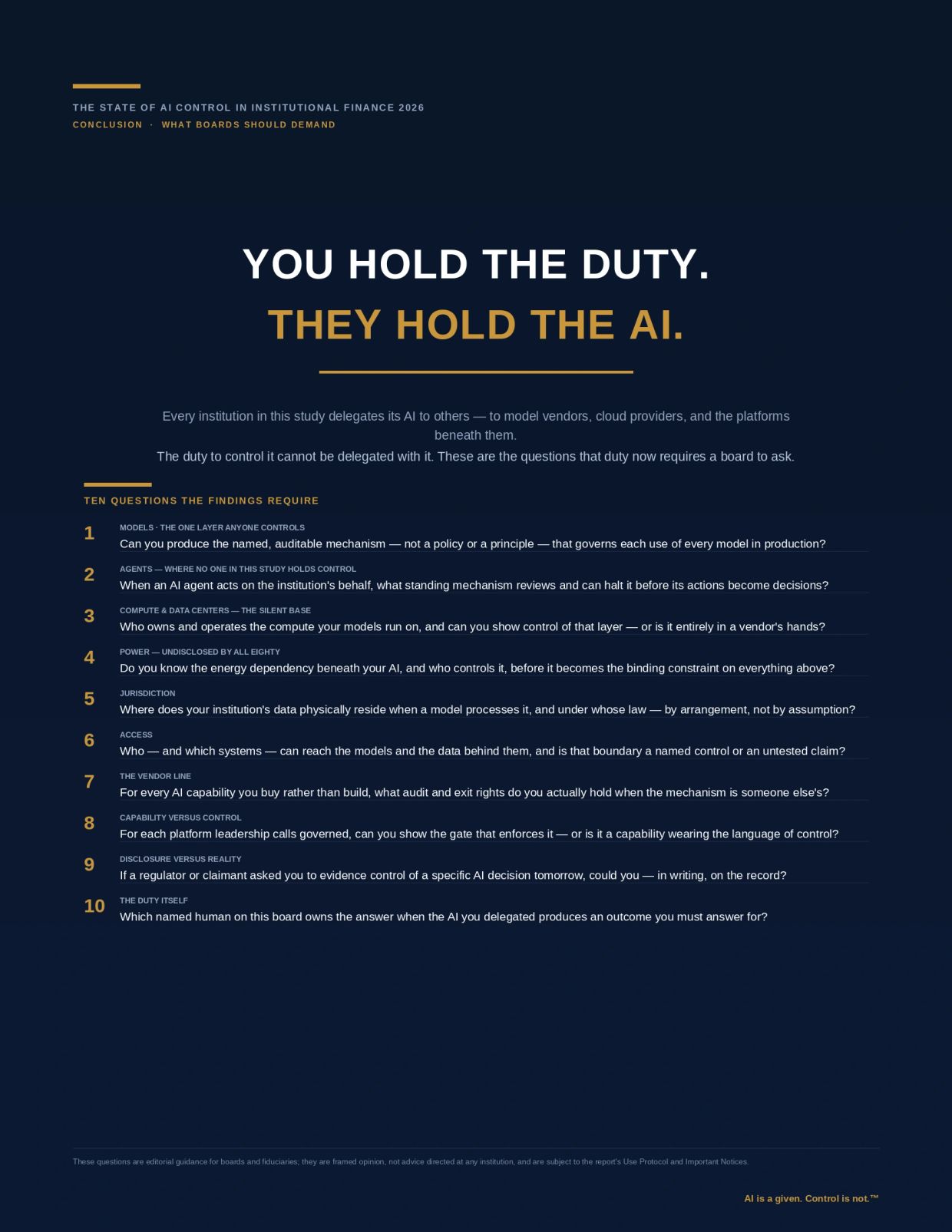
The distinction between control and demonstrable control is not a matter of documentation. It is the difference between believing an institution is in command of its AI and being able to prove it when proof is required — to a regulator conducting an examination, to a client performing due diligence, to a beneficiary whose assets were influenced by an AI-driven decision, or to a board accountable for institutional oversight.
For much of the last decade, financial institutions could reasonably rely on established control frameworks, mature operating environments, and trusted technology providers. Artificial intelligence changes that equation. AI is increasingly probabilistic rather than deterministic, delegated rather than owned, and embedded in decisions that were once the exclusive province of human judgment. As dependence on AI grows, confidence alone is no longer sufficient. Demonstrable control becomes the standard.