
THE FRAMEWORK
The 5x5 Control Matrix™
This framework is the canonical description of the 5×5 Control Matrix™ and governs every chart and exhibit in our annual report.
THE TWO AXIS:
- The rows are the five ecosystems of the AI stack, read from the physical base upward: Power (the electricity that runs it), Compute (the chips and servers), Data Centers (where it physically sits), Models (the AI itself), and Agents (AI that acts on its own).
- The columns are the five pillars through which command over any layer is exercised: Jurisdictional (where workloads run, and under whose law), Logical (who may access what, and on what terms), Technical (cryptographic and isolation control over data and models), Operational (real-time visibility into what is actually happening), and Contractual (enforceable rights to audit, exit, and hold providers accountable).
THE FIVE TIERS:
Four ascending tiers of demonstrated command, plus one that records the absence of public disclosure.
- Sovereign. Demonstrable, end-to-end command of the cell — the institution can show control across the full chain, not merely a portion of it.
- Governed. Active, evidenced control with auditable mechanisms. Control is real and operating, and the mechanism is one a third party could audit, but it stops short of end-to-end command — typically because part of the layer is rented or a provider’s controls sit beneath the institution’s own.
- Evolving. Control intent and partial mechanisms are disclosed, but enforcement is not yet demonstrable. The distinction between Evolving and Governed is the distinction between a stated intention and an evidenced, auditable mechanism.
- Reactive. Dependence on others, with minimal disclosed control of the cell.
- ND — Not Disclosed (publicly). No public disclosure addresses the cell. ND is shaded neutral grey, and it makes no assessment of the institution.
What the tiers measure — and what they do not
Heat-map classifications reflect publicly available information reviewed under the methodology described in this report. They are not assessments or certifications of any institution’s actual internal AI capabilities or controls. Grey (Not Disclosed) indicates the absence of public disclosure, not the absence of control.
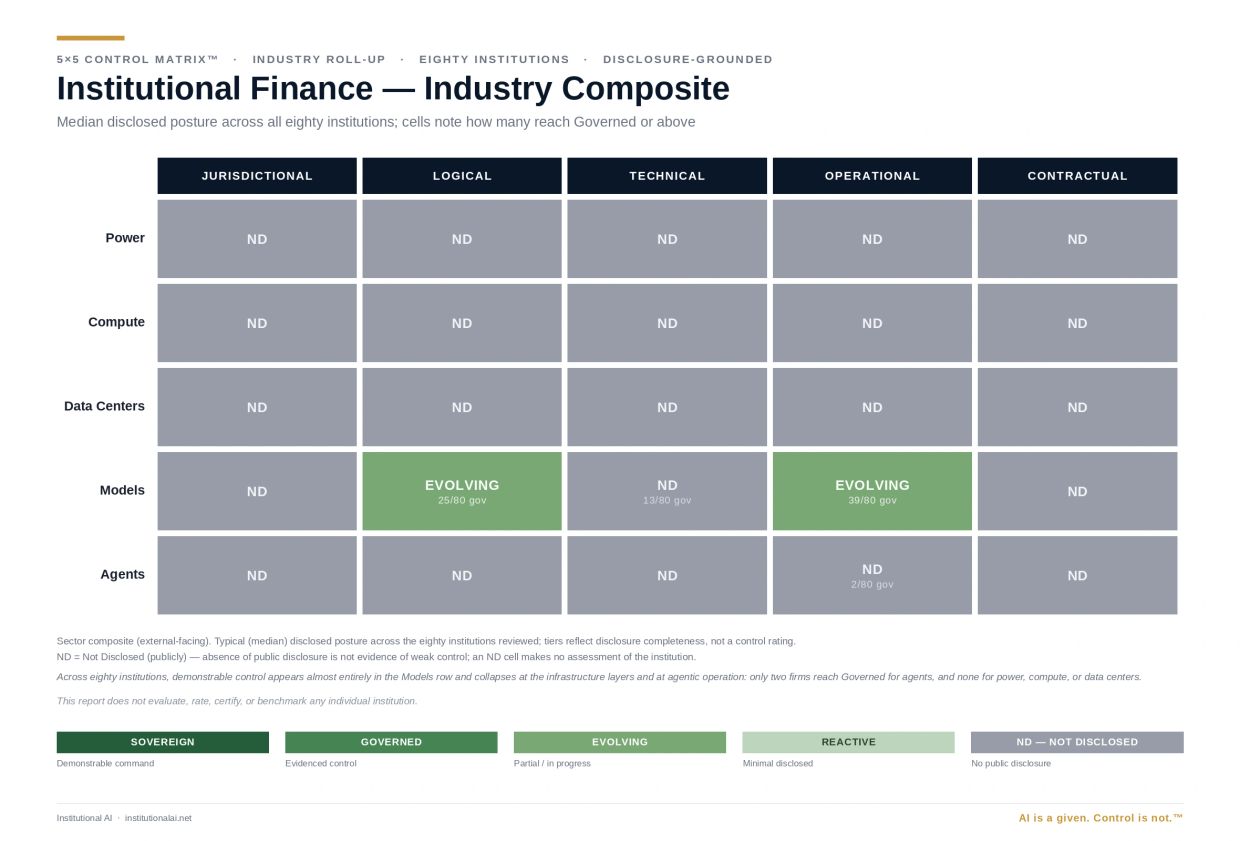
WHAT WE FOUND
We reviewed eighty of the world's leading financial institutions, across eight sectors, against a single question: not whether each uses AI, but whether it can publicly demonstrate control over the systems on which it increasingly depends.
The pattern is consistent. Where institutions demonstrate control, the evidence concentrates at the model layer — how models are governed, validated, and operated — and thins across the rest of the stack. Disclosure on autonomous agents is limited. On the infrastructure beneath them — compute, data centers, and power — it is sparser still.
A second theme recurs across every sector: the distance between aspiration and demonstration. Capability is described in the language of governance, and pilots in ways that suggest broader deployment, more often than the public record substantiates.
Governance describes what an institution intends to do. Control describes what it can demonstrably do. This report measures the distance between the two.
Why financial institutions are different
Deep — control runs the full stack.
Wide — control reaches across the chain.
Wide — control reaches across the chain.

The AI you rely on does not run on software alone. It runs on agents, models, data centers, compute, and power. The questions that decide your exposure — where it executed, under whose key custody, in which jurisdiction — live below the application layer. Control that stops at the software is not control.
Wide — control reaches across the chain.
Wide — control reaches across the chain.
Wide — control reaches across the chain.
You do not operate most of the AI you depend on. It runs inside your asset managers, your asset servicers, your providers — firms whose systems produce the numbers that land in your books and your duty. Control that stops at your own walls leaves the rest of your exposure unguarded.
The eight sectors

How the eight sectors compare
Based on publicly available information reviewed under our methodology, banks show the greatest prevalence of publicly disclosed AI control and private equity the least, with the other sectors distributed between them. Across every sector, demonstrated control concentrates at the model layer and thins toward the autonomous-agent layer now entering production.
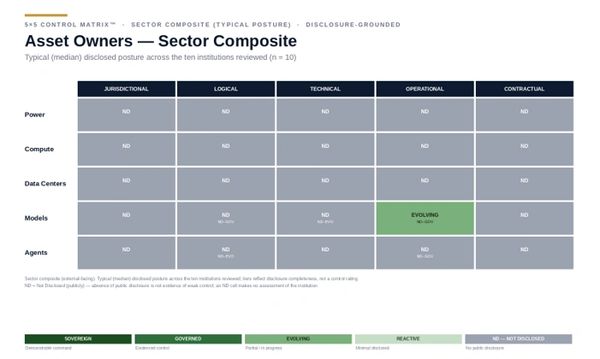
Asset Owners — The Stewards of Capital
Disclosed control sits at the model layer and remains partial at the typical level. A small number disclose named internal mechanisms that reach an evidenced standard; many disclose more about AI as an investment theme than about control of their own AI.
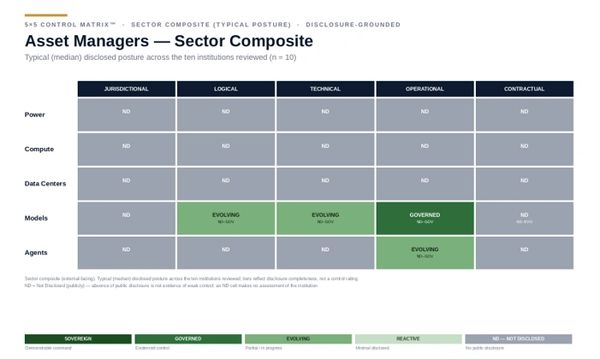
Asset Managers — The Allocators of Capital
Among the stronger-disclosing categories at the model layer. Most over-read at the agent layer, where capability is described as governed production more often than the record supports.
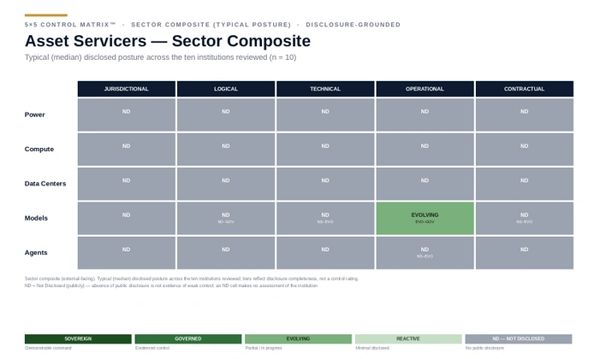
Asset Servicers — The Operational Backbone
Cluster at an evolving posture on the model layer. The sector illustrates the report's central distinction: a named platform is a capability, not in itself a control mechanism.

Banks — The Engines of Intermediation
The strongest-disclosing sector reviewed, with evidenced control across the logical and operational handling of models — and the only sector where any institution discloses command of the infrastructure layer.
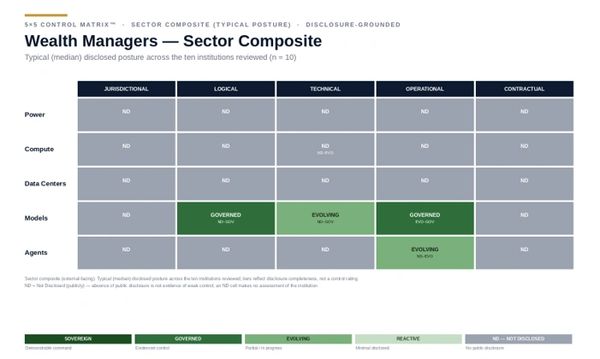
Wealth Managers — The Custodians of Advice
Reach an evidenced standard on the model layer at the typical level; several inherit disclosed control from a banking parent. Agentic operation is disclosed at an evolving stage.
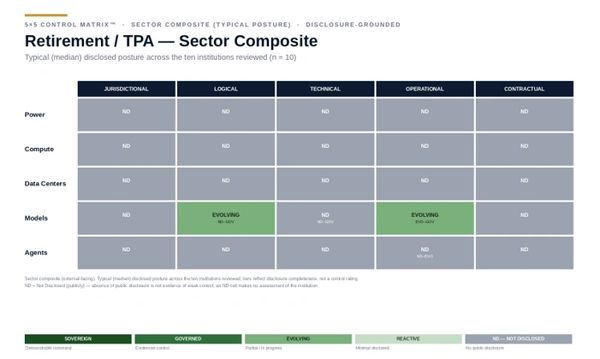
Retirement Providers — The Guardians of Long-Term Security
Sit at an evolving posture, with leaders reaching evidenced control through named, full-lifecycle governance frameworks and deployed tooling.
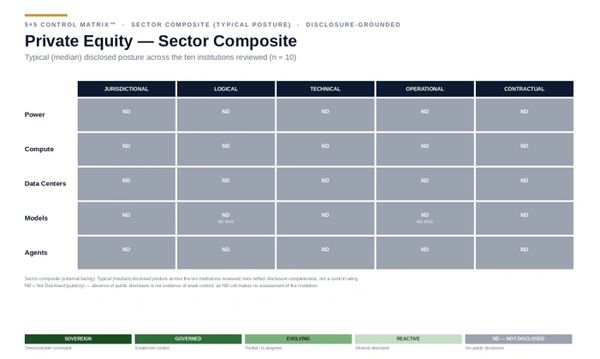
Private Equity — The Owners and Builders
The least-disclosed sector on the public record. The explanation is structural: the dominant footprint is investment in, and deployment of, AI elsewhere — not control of the firm's own AI.
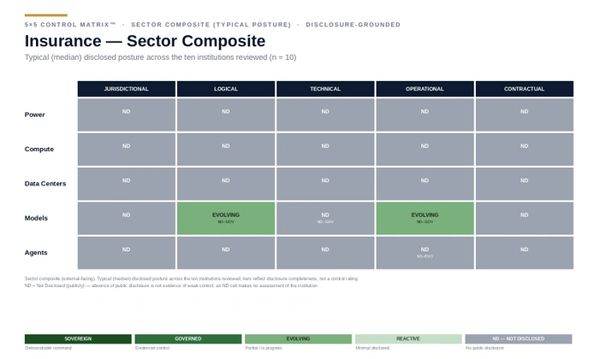
Insurance — The Protectors of Risk
An evolving posture with a leading edge among large European groups reaching evidenced control, reflecting a regulatory-culture effect: published, named governance frameworks with mandatory principles and accountability roles.
REQUEST THE REPORT
AVAILABLE ON A RELATIONSHIP BASIS TO QUALIFYING INSTITUTIONS
All discussions covered under NDA. Tiers reflect public-disclosure completeness, not assessments of any institution's actual controls.
AI is a given. Control is not.™
