The instrument - The 5×5 Control Matrix™
The 5×5 Control Matrix™
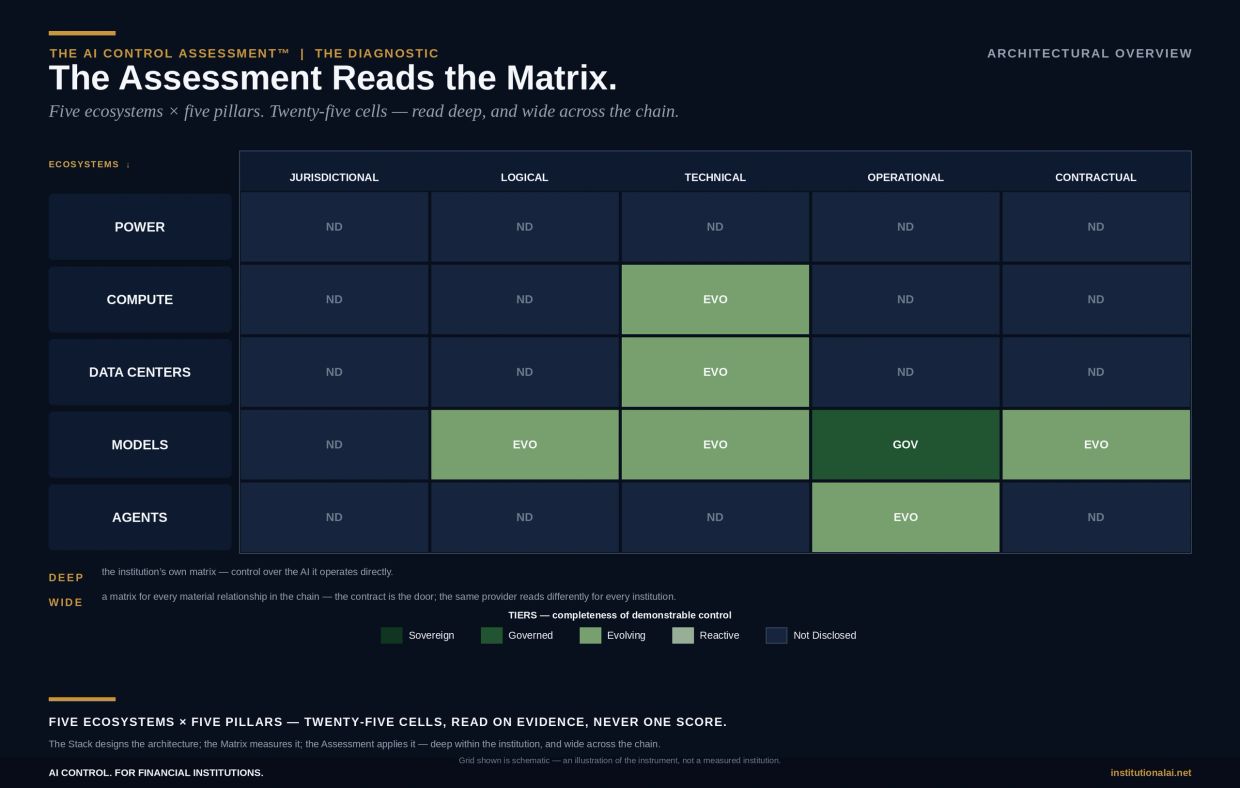
The instrument that measures how much control an institution can demonstrate over the AI it depends on. It reads the five ecosystems of the Institutional AI Stack™ — Power, Compute, Data Centers, Models, Agents — against five pillars of control: Jurisdictional, Logical, Technical, Operational, Contractual.
Twenty-five intersections, each placed on a five-tier scale and read cell by cell, never collapsed into a single score — because an institution can command its models while renting the data centers beneath them, and one number would hide exactly that.
One instrument. Deep and wide. One program.
The instrument and the ASSESSMENT
.png/:/rs=w:1240,cg:true,m)
The AI Control Assessment™
The 5×5 Control Matrix™ is the instrument. The AI Control Assessment™ is the diagnostic built around it.
The Matrix measures where an institution stands — its demonstrable ability to own, control, and audit the AI behind its decisions, across all twenty-five intersections of five pillars of control by five AI ecosystems. The Assessment applies that instrument in two directions.
- Deep — the institution's own matrix: its demonstrable control over the AI it operates directly, from power to agents.
- Wide — a matrix for every material relationship in its chain. Institutions do not operate most of the AI they depend on; it runs inside the managers, servicers, and providers they delegate to. The Assessment maps that chain and runs the same instrument on each — a distinct matrix per relationship, because the same provider reads differently for every institution. Control lives in the contract and the reach it grants, not in the vendor.
The Assessment sets the reading against your peer group, calibrates it to where your obligations require you to be, and returns the distance as a defined control program.
One instrument. Deep and wide. One program.
STEP 1 - THE 5×5 CONTROL MATRIX™
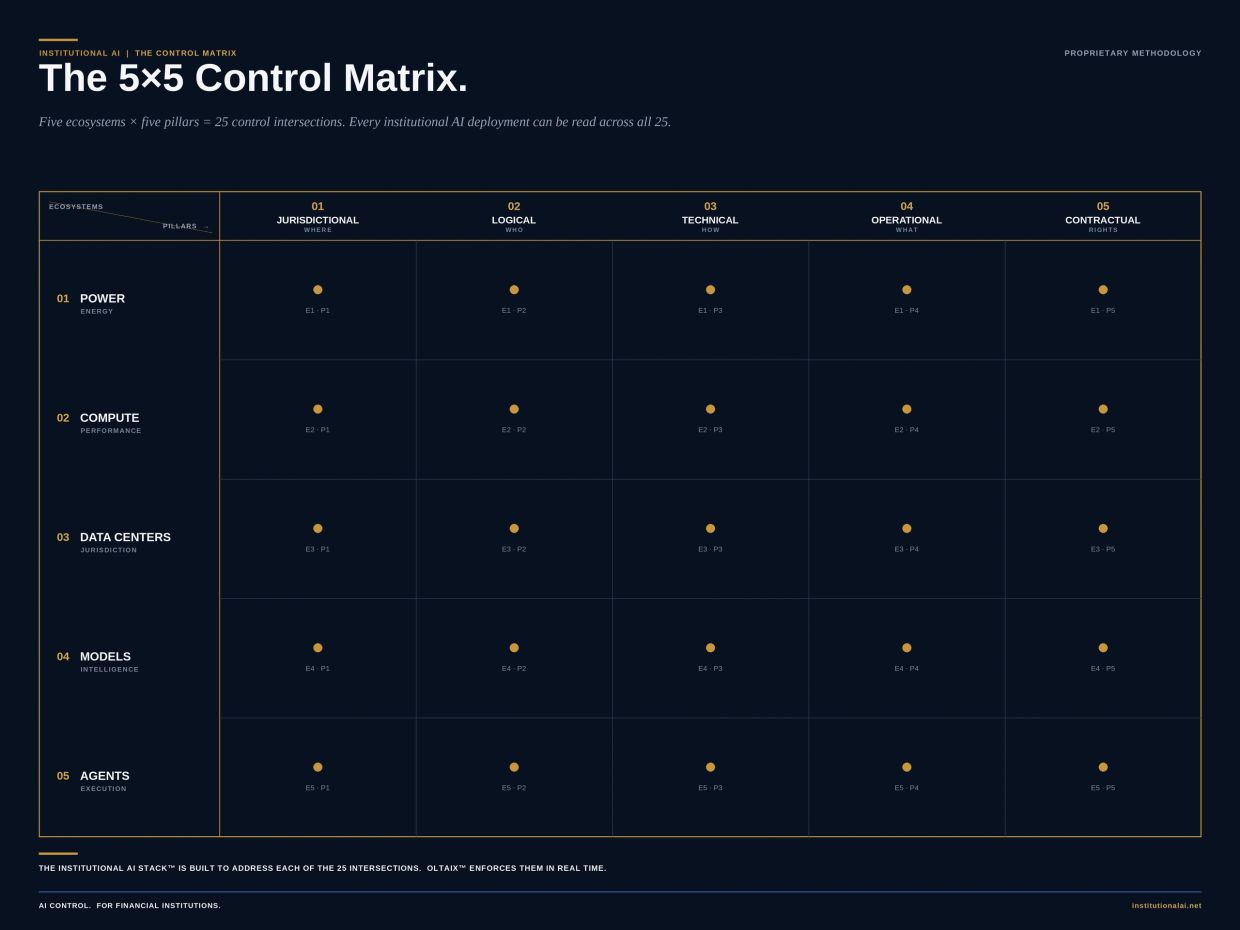
The Matrix reads your institution's demonstrated ability to own, control, and audit the AI systems behind its decisions. It applies five dimensions of control — Jurisdictional, Logical, Technical, Operational, and Contractual — independently to each of five AI ecosystems: Power, Compute, Data Centers, Models, and Agents.
The result is twenty-five specific, answerable control questions. Each intersection is placed on a five-tier scale — Sovereign, Governed, Evolving, Reactive, or Not Disclosed — according to what the evidence supports, not what policy asserts. The pattern across the twenty-five cells shows not only how well-controlled your AI is overall, but exactly which intersections are exposed and where investment will change the most.
The Matrix reads the record, not the reputation. A tier above the baseline requires an identifiable, auditable mechanism — control is never inferred from an institution's size, its spending, or the volume of its AI activity.
The finding that recurs. Across institution types, the Models and Agents ecosystems are consistently the least controlled. This is structural, not incidental. External model providers process institutional queries on their own infrastructure, retain interaction logs in their own systems, and operate under terms most institutions have never negotiated against their fiduciary obligations. Enterprise tiers offering zero-retention and confidential inference exist; few institutions have negotiated them, and fewer still have verified that what the contract promises is what the architecture actually enforces. This is not a worst-case scenario. It is the ordinary operational reality of how AI is served today.
STEP 2 — HOW DO WE COMPARE? SECTOR BENCHMARKING

A control position means little in isolation. Governed at one intersection, Evolving at another — read alone, the reading is a fact without a verdict. What makes it actionable is context: the same posture that is defensible for one institution is an examination finding waiting to happen for another, and the difference is entirely where its peers and its regulators expect it to stand.
Benchmarking supplies that context in two frames.
- Against your sector. An institution is first measured against those that share its obligations — a custody bank against custody banks, a public pension against public pensions, a life insurer against life insurers. Sector is where the standard is set, because sector is where the regulator, the mandate, and the fiduciary duty are the same. A wealth manager's control posture is judged by what wealth managers are expected to demonstrate, not by the market as a whole.
- Against the industry. The sector reading is then set against the broader financial-services record — the pattern established across eighty institutions and eight sectors. This is where an institution learns whether its sector is ahead of the industry or behind it, and whether a posture that looks strong among its immediate peers is in fact lagging the direction the whole system is moving.
Together, the two frames turn a standing into a position, and a position into urgency. A posture that looks acceptable within a sector can still sit behind the industry's trajectory. A posture that leads the industry can still fall short of what a particular sector's regulators require. The board question is not "is our control good?" — it is "is our control keeping pace with the institutions we are measured against, and with where the whole system is heading?"
The benchmark does not grade an institution's control. It tells the institution whether its control is keeping pace — and the moment it sits below where comparable institutions already stand, that is no longer an analytical observation. It is a matter the board must act on.
STEP 3 — WHERE DO WE NEED TO GO? THE STRATEGIC DIRECTION
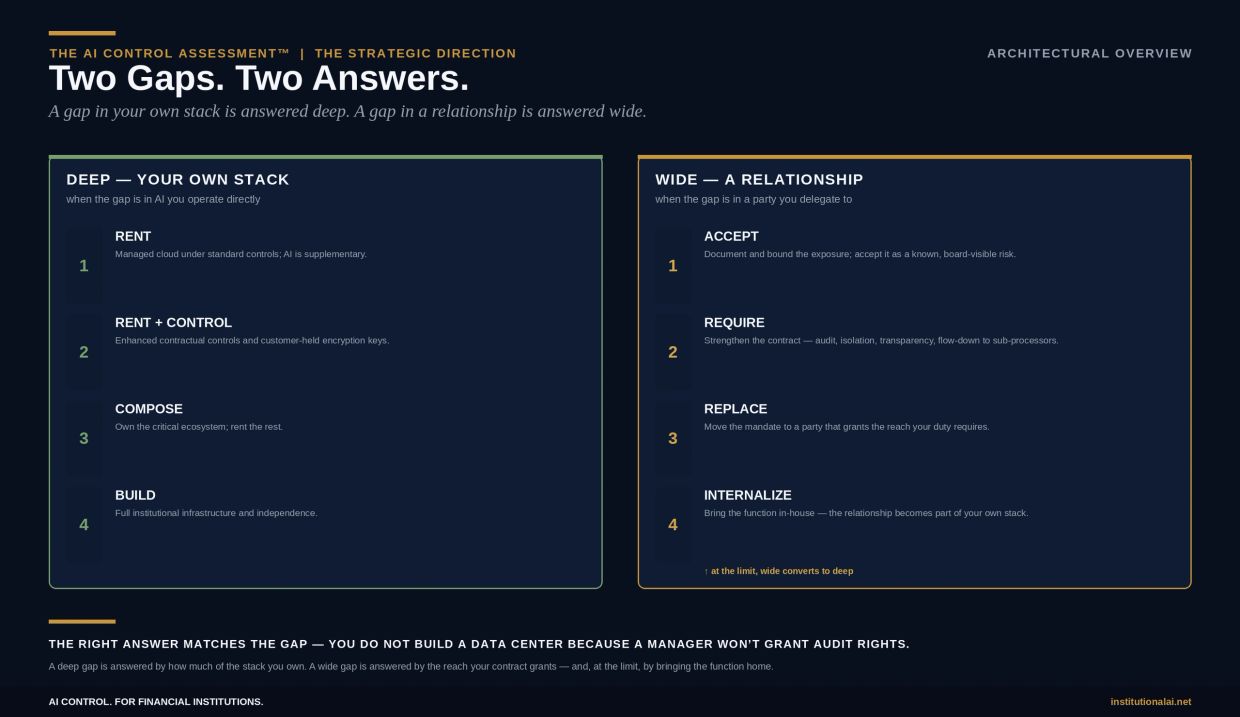
A gap in control has two possible locations, and each is answered differently. A gap in the AI an institution operates directly is a question of how much of the stack it should own. A gap in a relationship it delegates to is a question of how much reach its contract should grant. The strategic direction addresses both.
When the gap is deep — in your own stack. The evaluation weighs your regulatory obligations, AI dependency, risk tolerance, and operating model, and points to one of four infrastructure strategies:
- RENT — Managed cloud under standard controls; AI is supplementary.
- RENT + CONTROL — Enhanced contractual controls and customer-held encryption keys.
- COMPOSE — Own the critical ecosystem; rent the rest.
- BUILD — Full institutional infrastructure and independence.
When the gap is wide — in a relationship. You do not build a data center because an asset manager will not grant audit rights. A gap in a delegated relationship is answered through the contract and the reach it grants — a parallel set of four responses, escalating from acceptance to ownership:
- ACCEPT — Document and bound the exposure; accept it as a known, board-visible risk. The right answer when the relationship is immaterial or the exposure is contained.
- REQUIRE — Strengthen the contract: audit rights, data isolation, transparency, and flow-down to sub-processors. Same relationship, greater reach — the answer to most wide gaps.
- REPLACE — Where a party will not grant the reach your duty requires, move the mandate to one that will.
- INTERNALIZE — Bring the function in-house. At the limit, the relationship becomes part of your own stack — a wide gap converted into a deep one, where the strategies above apply.
Neither ladder is a judgment that more control is always better. The right response is the one the gap and your obligations require — which, for most institutions, is Rent + Control or Compose deep, and Require or Replace wide, far more often than Build or Internalize.
The Gap Is the Program
.png/:/rs=w:1240,cg:true,m)
Read intersection by intersection, and relationship by relationship.
An assessment that only tells an institution where it stands has done half the work. The value is not the reading itself, but the distance it reveals.
Three measures define that distance.
- The Matrix establishes where control can be demonstrated today — across all twenty-five intersections, deep within the institution and wide across its material delegation chain.
- The strategic direction establishes where the institution needs to be — whether Rent, Rent + Control, Compose, or Build, based on its obligations, dependencies, risk tolerance, and operating model.
- The benchmark establishes urgency — because a control position that appears acceptable in isolation may look very different against its peers or leading practice.
That distance, read cell by cell and relationship by relationship, becomes the control program: a prioritized sequence of what must be addressed, where accountability sits, which dependencies matter most, and what closes each gap.
Prioritized by impact. Sequenced by dependency. Owned by the institution.
This is where diagnosis becomes control.
The AI Control Assessment™ defines the gap; the Institutional AI Stack™ provides the architecture to close it; OLTAIX™ is the control fabric that sustains it.