
AI Control in financial services has a shape.
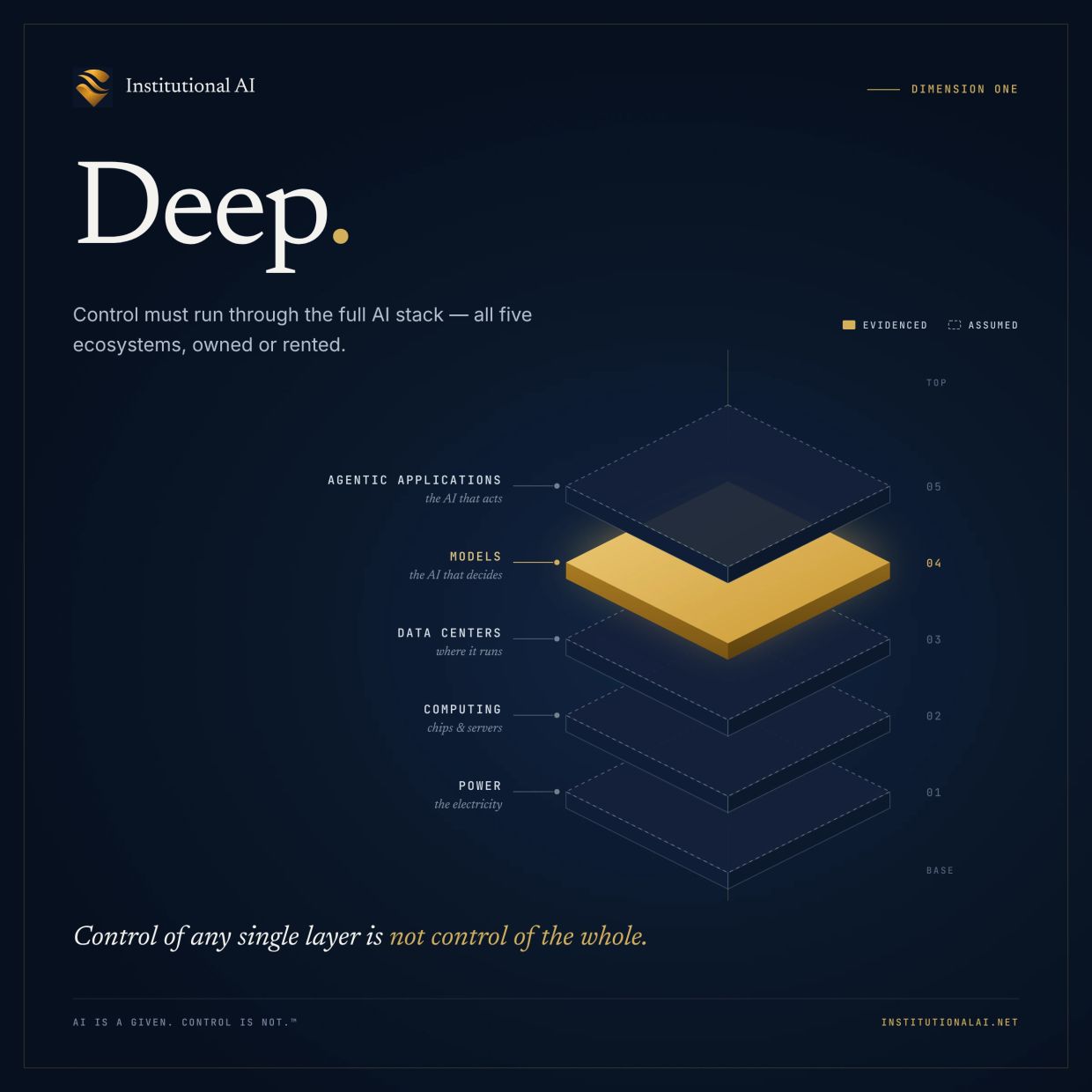
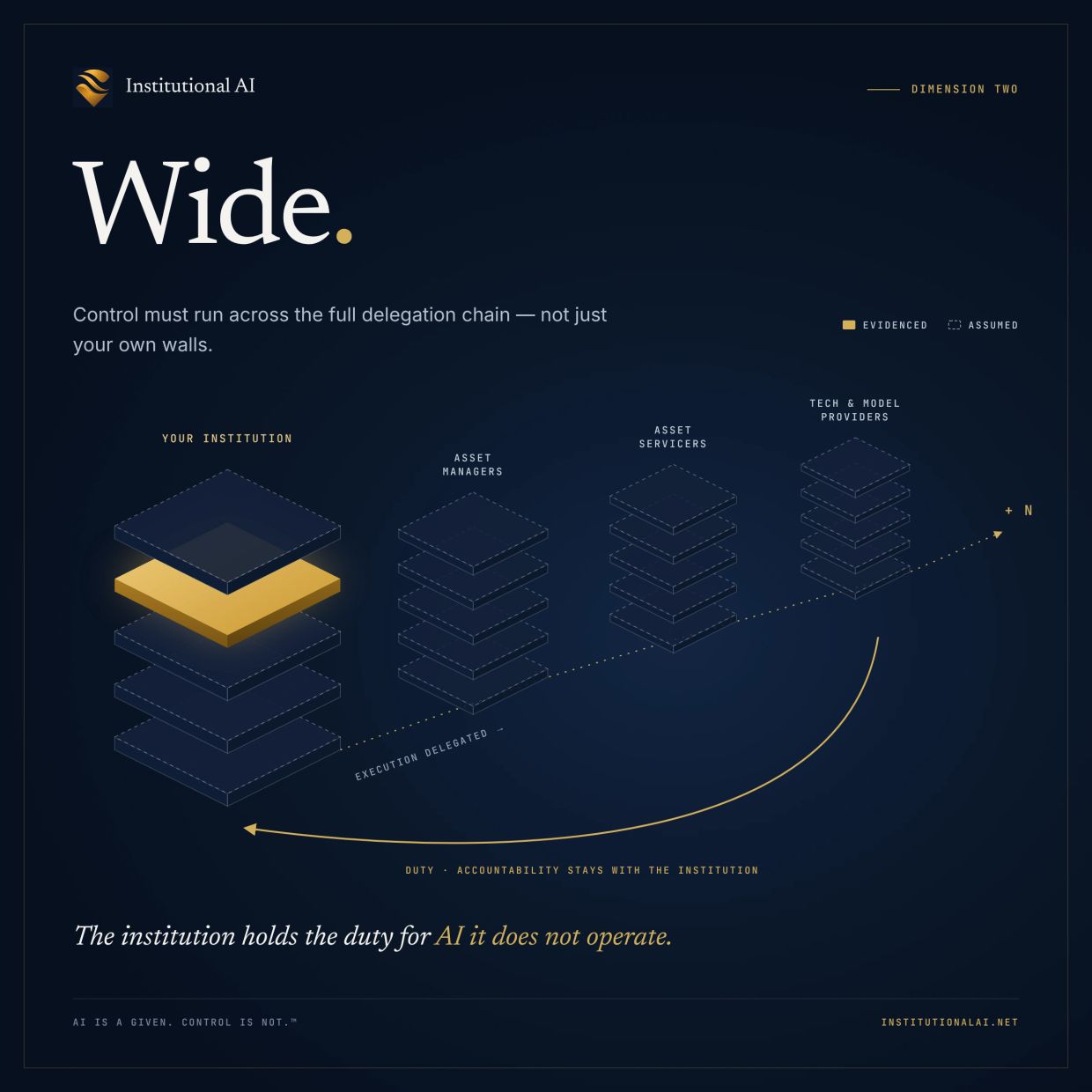
It must be deep, and it must be wide.
The industry has largely treated AI as a new software technology — the models and agents that fill the headlines. But artificial intelligence does not begin and end there. It runs deeper — and reaches wider — than the software an institution sees. Control must therefore run in two directions at once.

THE EVIDENCE
80 INSTITUTIONS · 8 SECTORS · ONE 5×5 CONTROL MATRIX™
Institutional AI reviewed the publicly available disclosures of eighty of the world's leading financial institutions. The public record indicates that AI adoption is widespread, while publicly demonstrable Institutional AI Control—both deep across the AI Stack™ and wide across the institutional operating ecosystem—remains limited.
Where evidence is publicly disclosed, it is concentrated primarily at the model layer. Beyond models—into autonomous agents above and the power, compute, and data-center ecosystems beneath—publicly demonstrable control becomes markedly less evident.
For boards, executive teams, and risk leaders, the implication is straightforward: AI governance and Institutional AI Control are not the same. As artificial intelligence becomes increasingly embedded in institutional decision-making, understanding where demonstrable control exists—and where it does not—is becoming a defining question of institutional oversight.
REQUEST THE RESEARCH
Insights from eight sectors and eighty leading institutions.
All engagements and discussions are conducted under confidentiality protections, including non-disclosure agreements where applicable. Control Tiers represent Institutional AI’s analytical interpretation of the depth, specificity, and visibility of publicly disclosed AI control information and are not assessments, audits, certifications, or determinations of any institution’s actual control environment, governance practices, or operatio
AI is a given. Control is not.™

THE Sectors.

Asset Owners — The Stewards of Capital
Asset owners are the institutions whose fiduciary obligations make AI control categorical, not optional. Entrusted with the retirement security of workers, the wealth of nations, and the long-term promises made to beneficiaries and citizens, they are the entities to whom the institutional finance ecosystem is ultimately accountable — and command of AI across the system will depend on whether they can govern the systems increasingly shaping how capital is allocated across economies and generations.

Asset Managers — The Allocators of Capital
Asset managers are the institutions that transform capital into investment decisions. Positioned between asset owners and markets, they serve as the engines of allocation, research, and portfolio construction. Increasingly, AI is becoming embedded within the analytical and operational layers through which those decisions are made. As a result, the question is no longer whether asset managers will employ AI, but whether they can exercise sufficient control over the systems that increasingly influence investment judgment and fiduciary outcomes.

Asset Servicers — The Operational Backbone of Capital
Asset servicers are the institutions whose operational responsibilities make AI control a foundational requirement. They are not merely providers of post-trade services; they are the entities that safeguard assets, maintain records, administer funds, and enable the functioning of the institutional financial system itself. In the final analysis, much of the trust upon which global finance depends ultimately rests upon their ability to maintain command over the increasingly intelligent systems that support the movement, accounting, and stewardship of capital.

Banks — The Engines of Financial Intermediation
Banks occupy a uniquely consequential position within institutional finance. They are not merely intermediaries between savers and borrowers; they are the institutions that facilitate payments, create credit, manage liquidity, and support the functioning of the broader economy. As AI becomes embedded across these activities, control ceases to be a technology issue and becomes a matter of safety, soundness, and systemic resilience. In the final analysis, command of AI within banking is inseparable from command of the critical infrastructure upon which modern finance depends.

Wealth Managers — The Custodians of Advice
Wealth managers are the institutions whose advisory responsibilities make AI control a categorical, not optional, requirement. They are not merely intermediaries between products and clients; they are the entities entrusted with guiding individuals, families, and institutions through decisions that shape long-term financial outcomes. As AI becomes woven into planning, research, and client engagement, control becomes inseparable from fiduciary judgment and trust. In the final analysis, the future of wealth management will depend not simply on access to intelligent systems, but on the ability to govern them in service of the clients whose interests wealth managers are entrusted to protect.

Retirement Providers — The Guardians of Long-Term Security
Retirement providers are the institutions whose responsibilities to participants and plan sponsors make AI control a foundational requirement. They are not merely administrators of retirement plans; they are the entities entrusted with safeguarding the long-term financial well-being of millions of individuals and families. As AI becomes woven into recordkeeping, advice, operations, and participant engagement, command of intelligent systems becomes inseparable from fiduciary responsibility and trust. In the final analysis, the strength of the retirement system itself will depend in no small measure on the ability of retirement providers to govern the technologies that increasingly shape retirement outcomes.

Private Equity Firms — The Owners and Builders of Enterprise
Private equity firms occupy a unique position within institutional finance. They are not merely allocators of capital; they are the institutions that exercise ownership, influence management, and shape the strategic direction of thousands of enterprises worldwide. As AI becomes a core driver of productivity and value creation, command of intelligent systems becomes inseparable from command of the businesses themselves. In the final analysis, the competitive advantage of private equity firms will increasingly be determined not only by the capital they deploy, but by their ability to govern the technologies transforming the companies they own.

Insurance Companies — The Protectors of Risk
Insurance companies are the institutions whose promises make AI control categorical, not optional. As underwriters, claims payers, and long-term investors entrusted with safeguarding individuals, businesses, and societies against loss, they provide much of the stability modern economies depend on — and confidence in the insurance system itself will rest in no small measure on whether insurers can govern the systems increasingly shaping the pricing, transfer, and management of risk.
WHAT WE DO
The Institutional AI Stack™ — the architecture.
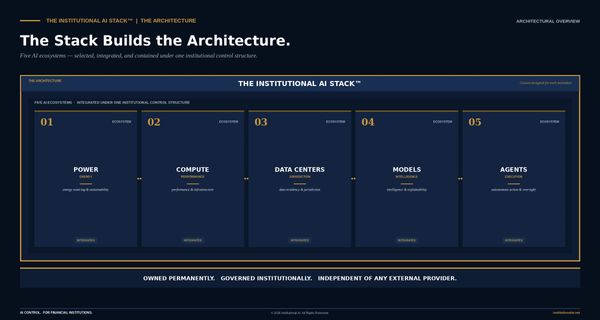
Deep control begins with the Institutional AI Stack™ — the five ecosystems institutional AI runs on: Power, Compute, Data Centers, Models, and Agents. Most institutions see AI at the top of the stack — the models and agents in the headlines. But those run on data centers, compute, and power an institution rarely owns and often cannot see.
Deep AI control reaches through every layer, owned or rented, to the lowest one an institution can account for. What you rent, you are still accountable for.
The 5×5 AI Control Matrix™ — the INSTRUMENT.
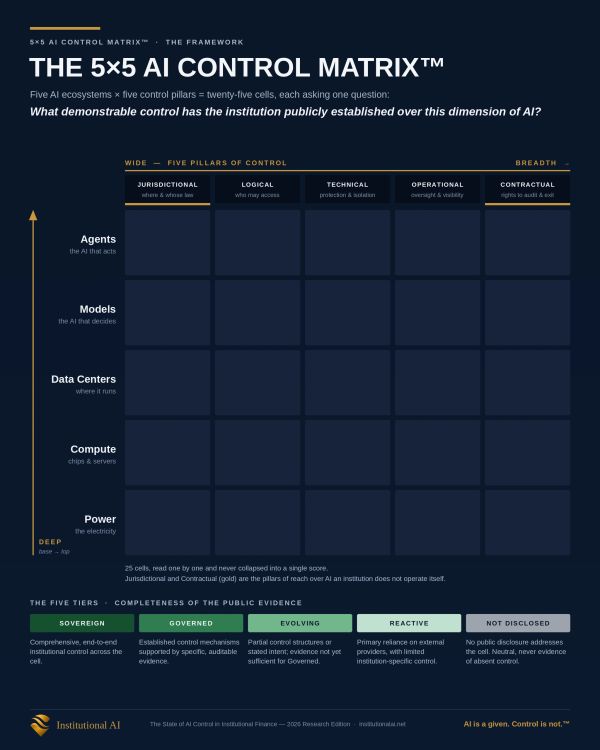
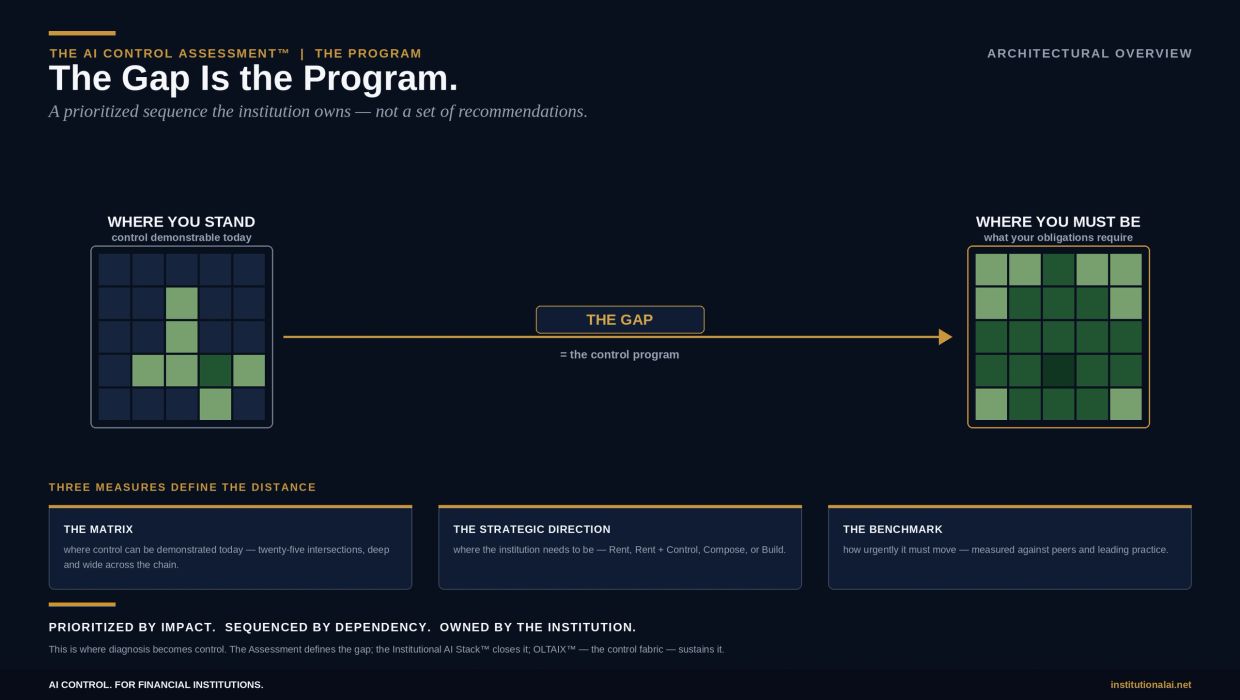
The 5×5 AI Control Matrix™ is the instrument that measures how much control an institution can demonstrate over the AI it depends on. It reads the five ecosystems of the Institutional AI Stack™ — Power, Compute, Data Centers, Models, and Agents — against five pillars of control: Jurisdictional, Logical, Technical, Operational, and Contractual. Twenty-five intersections, evaluated cell by cell rather than collapsed into a single score — because an institution can command its models while renting the data centers beneath them, and a single number would hide exactly that.
The Matrix documents where control is evidenced, where it is assumed, and where it is absent. It is applied through the AI Control Assessment™, which runs it in two directions — deep within the institution, and wide across every material relationship in its delegation chain.

The AI Control Assessment™ — the diagnostic.
The Assessment is where the instrument is applied. It runs the 5×5 Control Matrix™ across an institution's full AI footprint, in two directions.
Deep — the institution's own matrix. For an asset owner such as a public pension fund, this is one 5×5 reading its demonstrable control over the AI it operates directly, from power to agents.
Wide — a matrix for every material relationship in its chain. A pension fund does not operate most of the AI it depends on: it runs inside the asset managers it appoints, the asset servicers that custody and administer its assets, and the technology, infrastructure, and model providers beneath them. The Assessment maps that chain and runs the Matrix on each node — a distinct 5×5 per relationship. The same provider reads differently for every institution, because control lives in the contract and the reach it grants, not in the vendor.
The AI Control Assessment™ establishes the institution's demonstrable control position — deep, and wide across the chain — and sets the priorities to close the gaps: where control is evidenced, where it is assumed, where it is absent, and where the duty extends further than the institution can currently reach.
The output is not a policy binder. It is a control position a steward of capital can stand behind — before the board, the regulator, and the client.
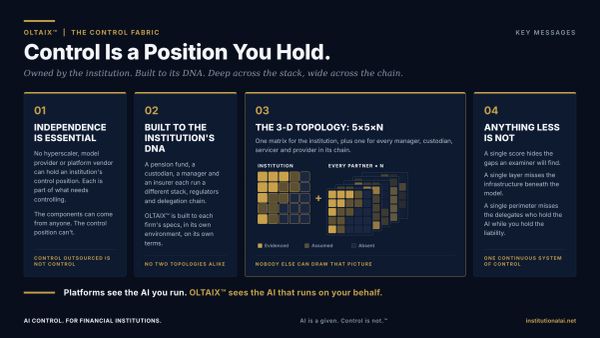
OLTAIX™ — THE Control Fabric.
Independent by design. You can delegate work to a hyperscaler, model provider or platform vendor. You cannot delegate fiduciary duty. Control outsourced is not control.
Built to your institution. Every institution carries a different fiduciary footprint. You build OLTAIX in your own environment, on your terms, and you own it.
5×5×N. One 5×5 AI Control Matrix™ for your institution, which is deep. One for every material partner, which is wide. Together they show where control is evidenced, assumed or absent across the chain your capital depends on.
Anything less is not AI control. Lock what you run. Verify what you don’t.
Disclosed to qualifying institutions under NDA.

How It Fits Together.
Institutional AI Control is not four separate ideas — it is one.
- The Institutional AI Stack™ is the architecture: the five ecosystems every institution's AI runs on, from power to agents.
- The 5×5 Control Matrix™ measures control across it — five ecosystems by five pillars, twenty-five intersections, read cell by cell rather than reduced to a single score.
- The AI Control Assessment™ reads that Matrix and defines the program.
- And OLTAIX™ operates the Stack under continuous control.
The architecture, the measure, the diagnosis, and the means to hold it — one system, deep across the stack and wide across the chain.
Questions Every Board Should Answer
The pattern of answers is the finding.
A board that asks these three questions and records honest answers will produce, in a single sitting, the most accurate picture of its real AI control posture it has ever held.
- The "Depth" question. "Our AI runs on five layers — the agents that act, the models that decide, the data centers that hold it, the compute it runs on, the power beneath. We may have examined one or two. Controlling the top layer while renting the four below is not control. Which layers have we verified, and which are we assuming?"
- The "Reach" question. "The numbers we book, the valuations we rely on, the decisions we answer for — more and more are produced by AI running inside the managers and servicers we delegate to, not inside us. We hold the fiduciary duty. They hold the AI. Have we verified their control, or delegated the work, kept the liability, and hoped?"
- The "Trust" question. "The firms that build these models run red teams whose job is to make them misbehave — and ship anyway, knowing they can. If the maker does not fully trust its own model, on what basis do we treat its output as reliable?"
Governance is policy. Control is evidence. These three questions separate the two. A board that can get them answered with technical proof — not provider assurance — has control. One that cannot has just found its exposure.
And these are only the beginning.